Xunpu flower-hair experience
The flower-ring hairstyle called zanhuawei (簪花围) is worth doing in Xunpu if you want the craft, the village and the photographs to support one another. It is a weaker choice if you want only an elaborate costume portrait: Xunpu is a compact residential community with working lanes, worshippers and ordinary traffic, not an open-air studio.
The best version is deliberately small. Choose the styling category before arrival, agree on every package component in writing, keep the village walk to a few public points, and leave time to remove or loosen the headpiece before it hurts. A styling-only session with phone photographs can be more personal than a rushed full package. A full package can be worthwhile when the assigned team shows relevant client work and the written delivery terms are clear.
This guide owns the styling, booking and shoot decisions. Read the separate Xunpu Village guide for the oyster-shell architecture and the reasons to treat Xunpu as a living coastal settlement rather than a costume backdrop.
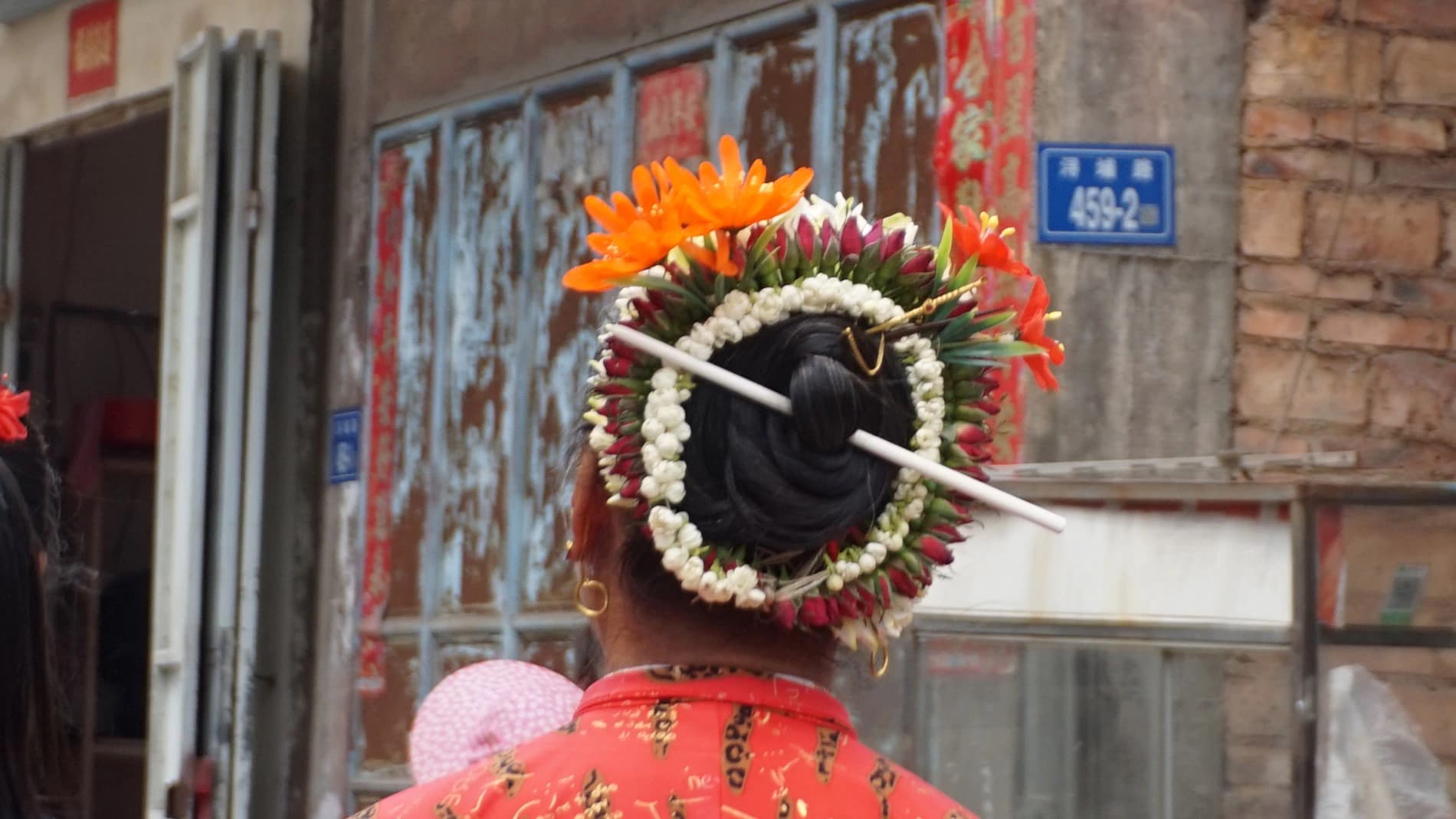
The circular bun, flower strings and long pin are easier to judge from the back than in a front-facing portfolio. Photograph by 三猎, CC BY-SA 4.0; cropped.
Decide whether the experience fits your trip
Choose Xunpu when you have half a day, can tolerate a fitted bun and want to connect the headwear to its home community. Two hours may cover simple styling and a short phone-photo circuit. A full look with makeup, outfit, professional photography, selection and changing back commonly occupies much more of the half-day, even when the advertised camera time sounds short. Ask the shop for a door-to-door schedule rather than adding its individual service times yourself.
Skip or simplify the experience when you have a scalp condition, a history of pressure headaches, a flower or cosmetic allergy, a tight train connection, or no patience for crowds. You can still visit Xunpu, see shell masonry from public lanes and learn what the headwear means. Wearing it is not required to appreciate it.
The experience is also independent of gender. Ask the shop to show the exact garment sizes and styling references it can provide rather than assuming its online gallery represents every body type. For children, keep the structure light, avoid sharp ornaments, obtain guardian consent for photographs and do not build a long shoot around an adult headpiece.
Know what is traditional and what is a commercial style
The local craft is more specific than “flowers in the hair.” Quanzhou's 2024 local craft standard describes a round bun fixed with a bone hairpin, flower strings arranged around it, and optional side flowers or metal ornaments. It distinguishes fresh flowers (生花) from artificial flowers (熟花) and sets out a full sequence from preparing and dividing the hair to forming the bun and adding the flower strings. Short or thin hair may require a false-hair foundation; that should be discussed before styling begins.
Traditional Xunpu women's clothing grew from coastal work. The Fujian culture department's description names a practical side-fastened blouse, broad sleeves and loose black trousers. A flower ring paired with that silhouette reads differently from a qipao, a mamianqun skirt, generalized hanfu, Southeast Asian-inspired dress or fantasy robe.
Commercial mixing is not automatically disrespectful or unattractive. It simply needs an honest label:
- Choose a traditional-reference look if the craft, working-clothing silhouette and restrained makeup matter most. Ask which parts follow the local standard and which are modern replacements.
- Choose a contemporary Xunpu-inspired look if you want brighter color, stronger makeup or a fashionable garment while keeping the flower-ring bun as the focus.
- Choose a creative costume portrait if you prefer a qipao, mamianqun, fantasy robe or another costume category. Enjoy it as a modern styling product rather than calling the full outfit traditional Xunpu dress.
Ask whether the flowers are fresh, artificial or mixed. Fresh material varies with season and supply; an online reference is not a guarantee of the same colors on your date. Artificial flowers can be lighter, predictable and easier in rain. Neither material determines whether the arrangement is skillful.
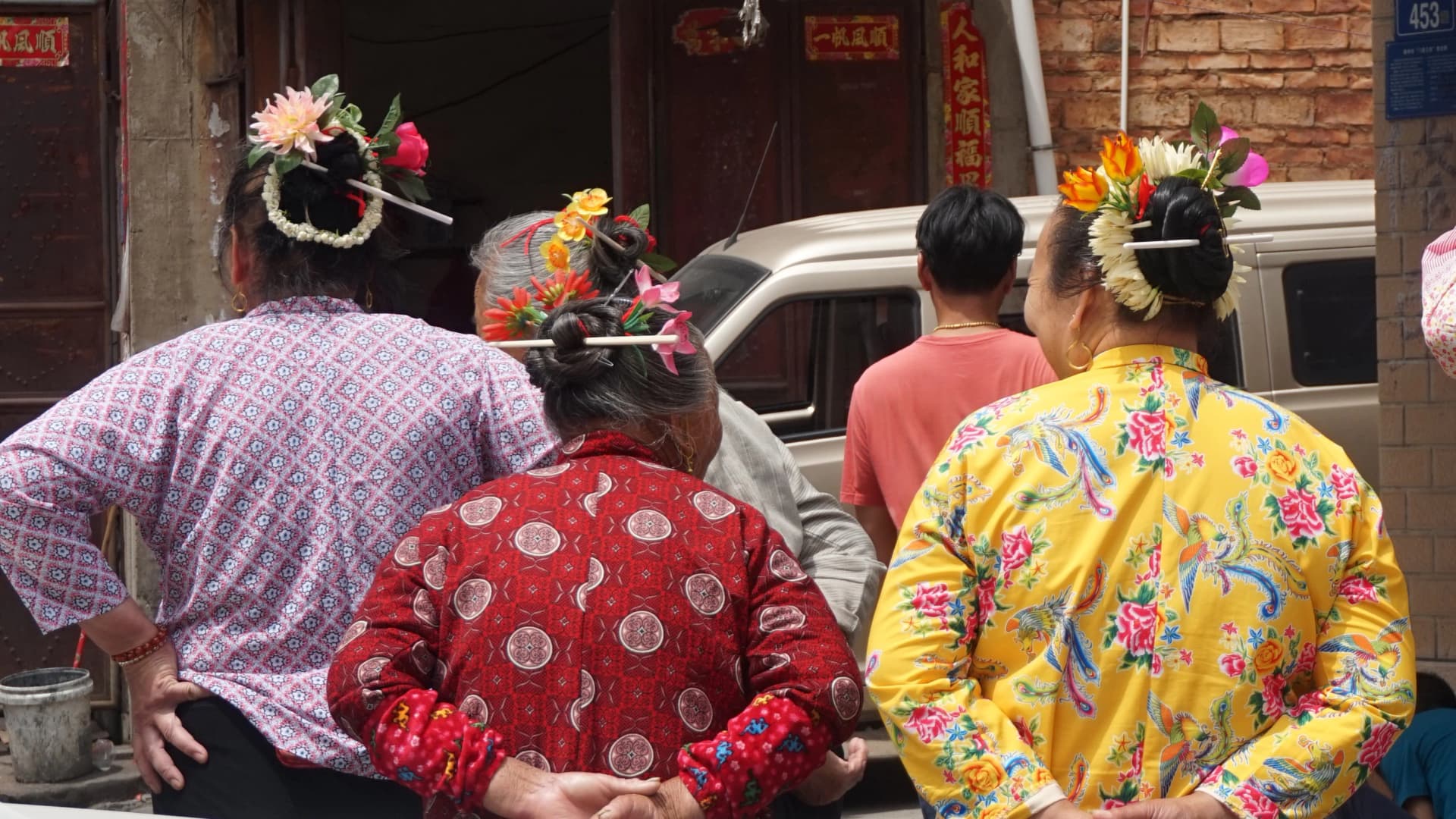
Everyday clothing and flower arrangements vary; a rental rack is only one commercial interpretation. Photograph by 三猎, CC BY-SA 4.0; cropped.
Choose one of four service levels
DIY flowers with your own clothes offers maximum comfort and minimum sales pressure. A simple floral comb or loose accessory is not the same craft as a complete zanhuawei bun, so describe it modestly. This choice works for travelers who want a small visual connection and a normal village visit.
Hair styling only is the strongest value for many visitors. Wear clothing you already move well in, use your own makeup and take phone photographs. Confirm whether the quote includes the bun foundation, flower strings, pins, removal help and a place to store your bag.
Hair plus outfit rental gives a clearer transformation while preserving control of photography. Check the garment before the bun is built: size, underlayer, hem length, fastening, shoes, accessories, cleaning rule, return time and damage deposit. Ask whether a second outfit replaces the first within the same rental period or starts a new charge.
Full styling and photography is easiest for solo travelers who want direction and finished files. It creates the most opportunities for confusion, because the salon, makeup, photographer, set access, file selection and retouching may be separate products. A “full package” is useful only when every dependency appears in the written scope.
Do not select a shop from one viral portrait or a low doorway price. Walk far enough to compare several current portfolios, then book the team whose ordinary client sets match your preference. The Fengze government report on the 2024 service standard says the standard covers service flow, charges, communication and feedback. That does not prove every merchant follows it; it gives you a reasonable basis for requesting an itemized quote and written feedback channel.
Make the price comparable
There is no durable online price band worth freezing into an itinerary. Shops change packages, photographers, seasonal flowers and promotional entry offers. Compare the same finished product instead.
Send this checklist to two or three current providers and ask each to return one final total:
| Component | What the written quote should state |
|---|---|
| Hair | Bun construction, false-hair padding, fresh/artificial flowers, number of flower strings, pins, ornaments, removal help |
| Clothing | Exact category, number of outfits, standard/premium rack, sizes, underlayer, shoes, accessories, deposit, cleaning and damage rules |
| Makeup | Base, lashes, hairline work, touch-up, sensitive-skin alternatives, removal, and whether the reference look costs extra |
| Photographer | Assigned photographer, actual camera minutes, number of public locations, indoor set access, lighting equipment and substitution rule |
| Files | Approximate captures, previews, included selections, all usable originals or not, resolution, file format, transfer method and link expiry |
| Retouching | Included count, editing strength, revision count, extra-image price, delivery date and rush charge |
| Logistics | Meeting point, village walking, any vehicle, admission or location fee, overtime, late return and after-hours contact |
| Changes | Deposit, cancellation, lateness, rain, illness, photographer cancellation, venue restriction and refund method |
| Image use | Personal license, studio portfolio permission, advertising use, social posting, storage period and deletion request |
Ask whether an outdoor scene, an indoor set and a private prop wall are separate chargeable locations. “Village exterior” is too vague: write the intended public anchors into the order. At selection, ask staff to pause while you compare similar frames and show the new total before you add files. A short selection deadline, rapid scrolling or “already retouched” previews should not push you into buying near-duplicates.
Check the real portfolio, not the cover image
Request two recent, complete client sets from the assigned photographer. One should use the same service level and public locations you want; the other should show similar height, build, skin tone or hair length. If the appointment crosses sunset, inspect both daylight and low-light work.
Look for consistency rather than one spectacular frame:
- the promised oyster-shell lane or temple exterior is actually present;
- flower detail remains sharp without turning skin into wax;
- full-length files show the garment and shoes rather than cutting every frame at the waist;
- people are directed without blocking a doorway or worship route;
- skin tone stays plausible in sun and shade;
- retouching does not change face shape or body proportions unless requested;
- several distinct compositions appear, not twenty versions of one pose;
- original and retouched file examples can be compared.
Agree on retouching limits before the shoot. State which moles, lines, proportions and skin tones must remain. Ask whether you can reject a photographer substitution or styling change. Save the listing, portfolio screenshots, payment record and chat until delivery is complete.
Protect comfort before leaving the chair
Ask the stylist how to prepare your hair. Requirements vary with the bun method, so do not rely on generic advice to arrive with freshly washed, heavily conditioned or product-free hair. Disclose extensions, scalp tenderness, migraines, recent coloring and allergies to flowers, hairspray, latex or adhesive.
Once the full headpiece is assembled, test it for ten minutes. Turn slowly left and right, look down, walk through a doorway and sit upright. Request immediate adjustment if a pin scratches, the bun pulls in one point, an ornament limits vision or the structure leans. “It will settle” is not a reason to endure sharp pain, numbness or dizziness. Take a phone photograph of the back before leaving so a loose element is easy to identify.
Choose the garment before makeup and hair whenever possible. Walk ten steps, sit, stand, raise both arms and climb one ordinary step. The hem must clear your shoes. Keep a compact bag with water, sunscreen, tissues, blotting paper, lip color, a power bank and any prescribed medication. In hot weather, shorten the route and take shade breaks; in rain, prioritize non-slip shoes over the photographed footwear.
Use a compact, verified village route
Save the exact pins before arrival. Chinese names are more reliable than an English search:
- Start at Xunpu Folk Culture Village 蟳埔民俗文化村. Choose a shop only after checking its current portfolio and written terms.
- Walk to Xunpu Village Oyster-Shell House 蟳埔村蚵壳厝. AMap returns about 200 m and 3 minutes from the arrival marker before crowds and photography stops.
- Continue to Quanzhou Shunji Palace 泉州顺济宫, roughly another 200 m and 3 minutes from the shell-house pin.
- Use only open public lanes beyond the palace. A waterfront or pier mentioned in a post is not a stable public-access promise; follow same-day signs and turn back when a lane becomes residential, operational or restricted.
- Return to the shop with enough time to change, inspect belongings and remove the headpiece without rushing.
These are map legs, not a six-minute shoot. The lanes are narrow and residential; a few hundred metres can take an hour when you wait for circulation, frame photographs and stop for water. Do not enter a shell house because an old post treated it as a set. Do not lean equipment on shell masonry, move residents' objects or occupy a threshold.
At the oyster-shell stop, take one wide environmental frame, one three-quarter portrait and one detail of flowers against the texture. Then move. A small, repeatable list is kinder to the lane than performing a long sequence at the same doorway.
Treat Shunji Palace as a place of worship
Shunji Palace is an active Mazu space, not a guaranteed portrait set. The public exterior and roofline can explain the village's religious context, but entry and photography inside depend on current instructions and worship activity. Put the camera away if a ceremony is under way. Never pose at an altar, sit on an offering table, touch ritual objects, use flash toward worshippers or block an entrance.
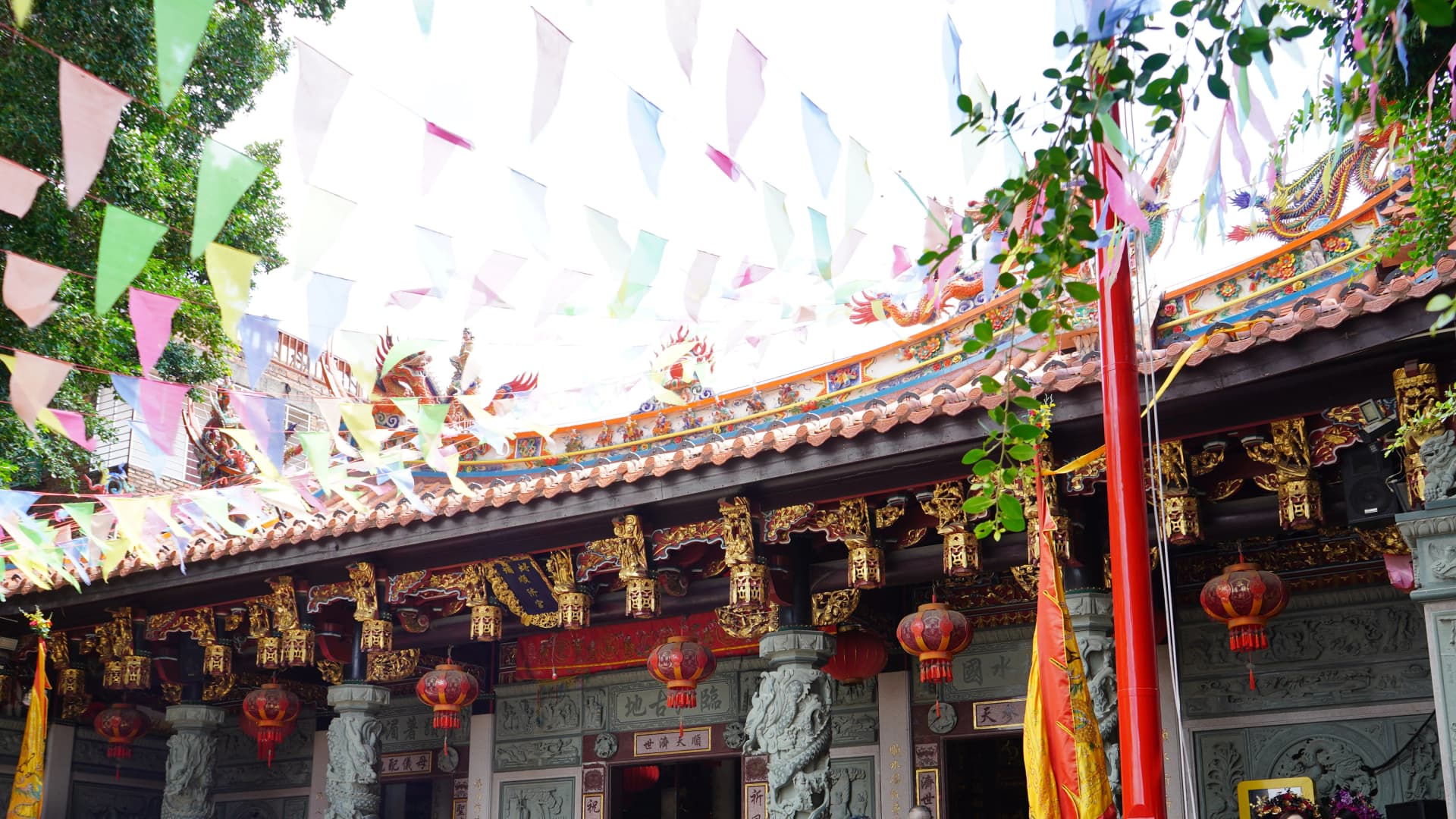
Use the roofline as context from a lawful public position; current worship and staff directions decide whether any closer photography is appropriate. Photograph by 猫猫的日记本, CC BY-SA 4.0; cropped.
An official 2024 notice about a Xunpu Mazu procession explicitly described it as a resident-organized religious custom rather than a street performance. The dated event is not a current calendar, but the boundary remains useful: do not wear a costume into a procession, direct participants or treat ritual movement as free production scenery. Observe from where residents and staff permit, and ask before photographing an identifiable person.
Time the light, not a copied clock
Morning usually gives a cooler, calmer route and simpler backgrounds, but a selected stylist or photographer may not begin early. Confirm the appointment rather than arriving before businesses open. Late afternoon can provide softer light and a possible waterfront finish, but the useful window changes by date, cloud and building shade. Check local sunset and rain shortly before the session, then work backward from the garment-return deadline.
A practical sequence is:
- Before styling: check weather, return time, pickup point and the three must-have frames.
- After styling: make a rear hair-detail photograph at the shop in neutral light. Fix loose flowers before walking.
- Soft daylight: shoot the full outfit and oyster-shell setting while details are readable.
- Last useful sun: choose either a public waterfront edge that is genuinely open or the palace roofline from outside. Do not chase both if crowds or access make the transfer slow.
- After sunset: stop unless the package includes a demonstrated low-light plan and a safe return. Dark village lanes are not a reason to set up intrusive lights.
Midday sun is hard on skin, flowers and stamina. Summer heat plus a fitted bun can feel much worse than the air temperature suggests. Rain can make shell-house lanes and thresholds slippery, flatten fresh flowers and mark long garments. Your written weather plan should say whether the appointment becomes styling-only, moves to a legitimate indoor set, reschedules or refunds a defined portion. A shop interior is private property; confirm that its sets are included and available rather than assuming rain grants access.
Get there and get back without a fragile plan
From Kaiyuan Temple 开元寺 in the old city to the Xunpu arrival marker, AMap returned about 14.7 km and 30 minutes by car before live traffic. The current transit result was about 63 minutes including roughly 920 m of walking, but routes and service patterns change. Open live navigation on the day instead of saving a bus number from this page.
Use a ride-hail or taxi when the appointment has a fixed makeup start, you are carrying styling supplies, or the return falls after dark. Save the exact Chinese shop name and an exterior photograph. Holiday traffic management, temporary pickup points and parking controls can change; ask the shop for the current lawful pickup point rather than asking a driver to stop in a narrow lane.
Do not stack a full photoshoot and Wulin Village into the same afternoon. The existing map route between Xunpu and Wulin is about 21 km by road before traffic. Pair them only with a confirmed transfer and a short styling session; otherwise give Xunpu the half-day and keep Wulin for another route.
Keep portraits, consent and refunds under your control
Costume does not create consent. Ask residents, craftspeople and other visitors before making them the main subject. Payment for a product or service does not automatically include portrait permission. Avoid photographing children unless their guardian clearly agrees. If a stranger dominates a frame, wait, reframe or remove that frame from the final selection.
Your own portrait rights also belong in the order. State whether the shop may use images in its portfolio, social channels, advertisements or training material. “No public use without separate written permission” is a useful default when privacy matters. Ask how long unselected photographs remain on the camera, studio computer and transfer platform, and how to request deletion. For minors, the guardian should control both delivery and usage permission.
Before paying a deposit, ask what happens when you cancel, arrive late, react to a cosmetic, dislike the first makeup check, encounter unsafe weather, lose access to a promised location or receive a substitute photographer. Separate a change of mind from operator non-delivery in the written rule. Photograph the garment at handover, report existing marks and obtain a receipt for any deposit. At return, ask staff to confirm the garment and accessories are complete before you leave.
Use a short shot list
Give a companion or photographer this list before the walk. It produces variety without turning the village into a production zone.
Eight still photographs
- Hair construction: tight rear frame showing the circular bun, flower strings and pin.
- Three-quarter headwear: side-back angle with no forced face turn, especially useful for privacy.
- Full outfit record: level camera, feet visible, plain public background before the lanes become crowded.
- Shell-house context: one wide frame with the subject small enough to show the masonry.
- Texture portrait: waist-up frame with flowers separated from the shell wall; do not lean on it.
- Walking frame: slow forward movement in an open public lane, photographer facing forward and watching traffic.
- Palace context: exterior roofline from a permitted public position, with the worship entrance kept clear.
- Closing detail: hands adjusting a sleeve or holding a removable flower away from traffic and ritual objects.
Four phone videos
Record one five-second still rear view, one slow side-back turn, one six- to eight-second walking clip and one static architectural clip without the subject. Use normal speed. Avoid repeated spins in a long hem, walking backward, or moving from bright sun into traffic while watching the screen.
Review three things before returning: a sharp hair detail, one complete outfit and one frame that clearly places the experience in Xunpu. If those exist, more files are optional. Confirm that the delivered link opens on your own phone before leaving Quanzhou, then make a second backup before any expiry date.
A low-friction half-day plan
Allow travel time from the Quanzhou old-city base, then keep the on-site sequence simple:
- Arrive with two saved clothing references and the written quote.
- Inspect and test the garment before makeup.
- Confirm headpiece weight, flower material, makeup direction and removal plan.
- Photograph the finished bun in neutral light and request adjustments immediately.
- Walk the arrival marker–oyster-shell house–Shunji Palace sequence.
- Add a waterfront edge only if current public access, weather and return time all support it.
- Return, change, remove the bun carefully, confirm files and close the deposit.
- Continue to the old city for dinner rather than wearing a painful headpiece through another long attraction.
This plan keeps the craft at the center without pretending a commercial portrait explains all of Xunpu. The village is still the subject; the styling helps you look more closely.