Kaifeng's immersive Song parks: choose one before you chase the shows
Kaifeng does not have one interchangeable cluster of “ancient Song sights.” It has modern performance parks, later historic monuments, archaeological evidence, active streets and museums. Mixing those categories creates the wrong trip: you can spend a full day watching staged battles and still learn little about what physically survives from the Northern Song capital.
For most first-time visitors, the park decision is simple:
- Choose Qingming Riverside Landscape Garden—also marketed in English as Millennium City Park—if you want a coherent river-and-market setting, easier photography, many short performances and the option of a separate large night show.
- Choose Wansui Mountain Martial Arts City if you want dense martial-arts entertainment, audience interaction, larger outdoor arenas and a louder day that rewards active show selection.
- Choose neither if surviving fabric, excavation and documented history matter more than themed entertainment. Use the Kaifeng Museum, Iron Pagoda, Shanshangan Guild Hall and city remains instead.
Do not attempt Qingming Riverside and Wansui Mountain on the same day. Both are schedule-led, outdoor and tiring. The cost of transferring is not only the drive; it is the lost chance to understand the second park's live programme, reserve a limited-capacity show, find the stage and arrive before the audience closes around it.
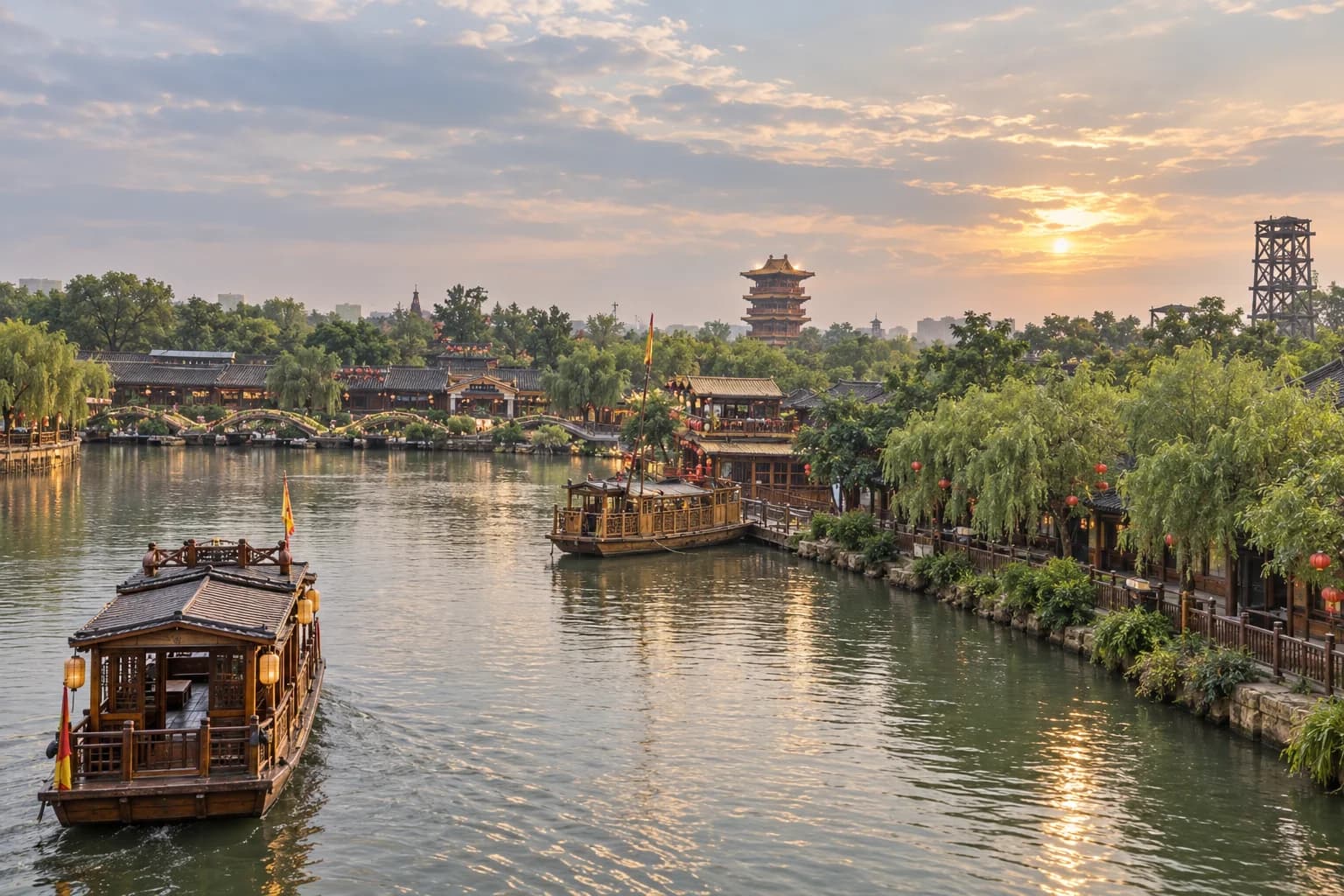
Use the water, streets and performance spaces to choose the experience you want. Buildings, boats, costumes and daily staging change; the park setting is modern interpretation rather than surviving Northern Song urban fabric.
The one-minute park chooser
| What matters most to you | Best choice | Why | Main trade-off |
|---|---|---|---|
| A first, visually coherent Song-themed day | Qingming Riverside | Canal, bridges, market streets and performance spaces form one legible setting | Popular shows still require walking, waiting and current-program checks |
| Martial arts, arena action and interactive characters | Wansui Mountain | The experience is built around action, roaming interaction and high show density | The programme can become a stressful checklist; shade and calm breaks matter |
| A polished ticketed night spectacle | Qingming Riverside, if the exact show product is operating and seats work for you | Da Song · Dongjing Menghua is a separate headline water production, not just a casual street show | Separate ticket/product rules, weather and a late exit require planning |
| Children who need variety rather than long historical interpretation | Either, after checking height/age and ride rules | Qingming offers a mixed landscape-and-show day; Wansui offers more overt action | Noise, pyrotechnic effects, animals, crowds and long waits may overwhelm some children |
| Older visitors or a group with limited walking tolerance | Usually Qingming Riverside, with a short priority list | A canal-and-street circuit can be simplified more easily | Cobblestones, bridges, outdoor queues and a late headline show can still be demanding |
| Costume photographs | Usually Qingming Riverside | The water-and-street background gives more varied portrait settings | Rental, makeup, deposit, return and photography products consume real park time |
| One day for actual history | Neither | Theme-park sets should not replace monuments, archaeology and museums | You give up the concentrated live-entertainment experience |
If your group is split, decide by what you will enjoy for six hours, not by one viral clip. A person who dislikes battle choreography will not be rescued by one spectacular night effect. A visitor who wants close NPC interaction may find a carefully landscaped canal beautiful but too passive.
What each place actually is
Qingming Riverside: a designed river city and performance park
Qingming Riverside Landscape Garden—清明上河园 (Qīngmíng Shànghé Yuán)—takes Zhang Zeduan's famous handscroll and the idea of Northern Song Bianjing as its creative starting point. It is a modern cultural theme park, opened in the modern era and repeatedly expanded. The canal, shops, gate towers and theatrical storylines help visitors imagine an urban world; they are not a preserved Northern Song district.
Its strength is spatial continuity. You can move from a water view to a market street, a small comic scene, a larger battle performance and a quieter garden without the day feeling like separate attractions. That also makes it the better default for a mixed group: one traveler can watch a show while another sits near the water, photographs architecture or takes a slower loop.
The park has two different products that travelers often blur together. General daytime admission covers the park and the current included programme according to the selected ticket. Da Song · Dongjing Menghua is a large night water show with its own ticket, seating, operating dates and weather exposure. Never assume a social-media timetable proves that it is performing on your date, that a particular seat block is available, or that buying the night show always includes exactly the same park-entry conditions. Read the selected product page before payment.
If Qingming Riverside is your choice, the dedicated park guide explains the internal visit in more detail. You can also check the current Trip.com park product, then compare the included admission, date, passport rules, refund terms and night-show wording with the official channel.
Wansui Mountain: a martial-arts entertainment city
Wansui Mountain Martial Arts City—万岁山武侠城 (Wànsuì Shān Wǔxiá Chéng)—is also a modern park. Its visitor identity is martial-arts and popular-literature entertainment: arena productions, roaming characters, comic interaction, choreographed combat, stage effects and busy night programming. Treat the “Song” and “jianghu” world as performance design, not as a claim that the buildings or events are surviving medieval evidence.
The decisive difference is density and audience behavior. Wansui rewards travelers who enjoy selecting shows, moving early and participating. Some limited-capacity headline performances have recently used a gate-first same-day reservation workflow through the official account or mini-program: the visitor must have a valid admission record before the reservation becomes available. That procedure, the participating shows and release rules are volatile. Confirm the official instructions on your visit day and never pay an unofficial “reservation agent” for a slot the park distributes through its own system.
The park is a poor choice for someone who wants a quiet architectural stroll or who will feel cheated after missing one headline event. Build the day around a genre mix, not three exact titles: one large arena production, one closer street interaction and one night effect if operating. The remaining encounters become bonuses.
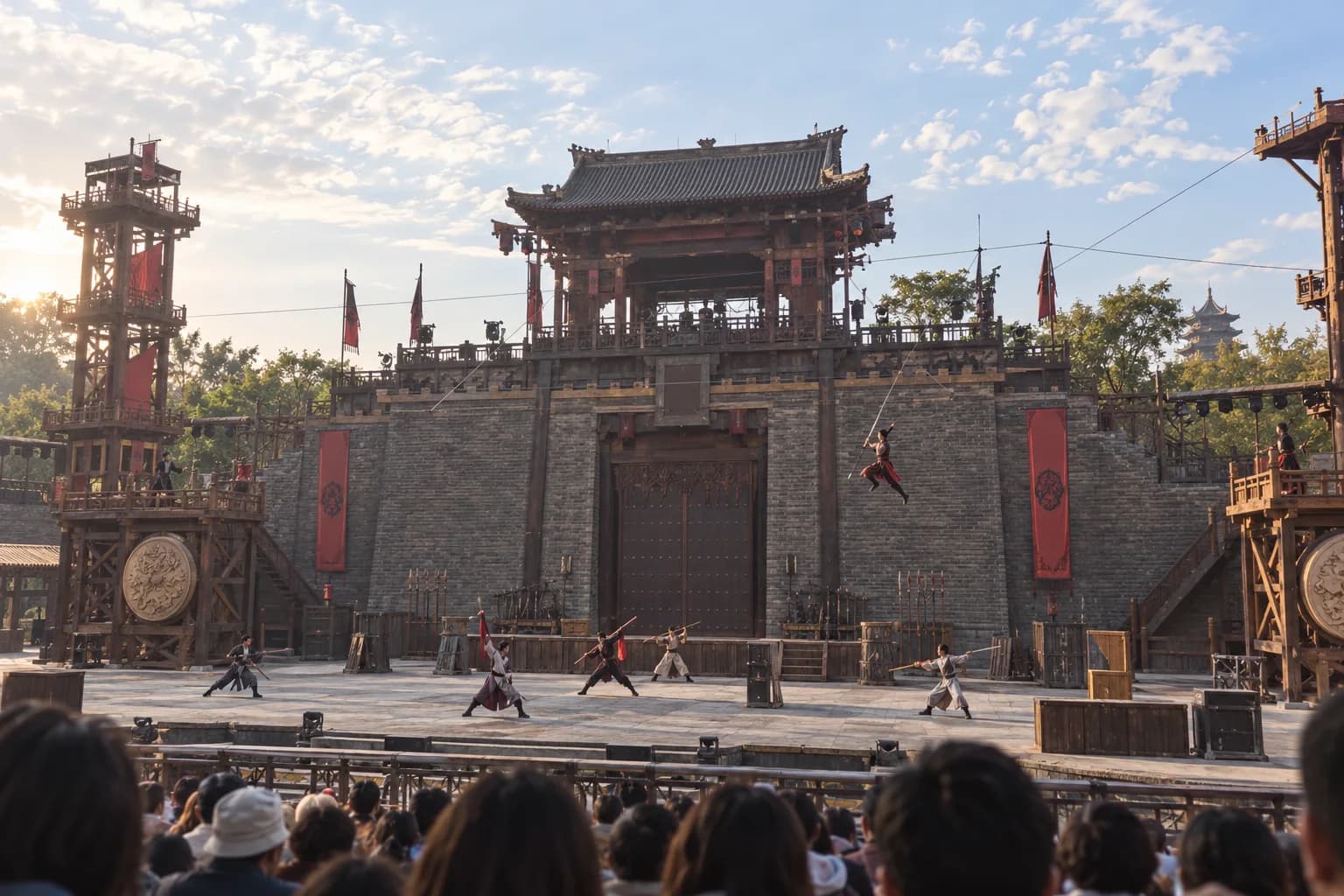
A wide outdoor stage explains the practical trade-off: large action reads from a distance, but the best sightline may cost a long wait. This scene is planning context, not proof of a current Wansui set, cast or programme.
Kaifeng Prefecture: compact interpretation, not an all-day park
Kaifeng Prefecture is useful when you want a shorter, more central themed visit. It is a modern reconstruction associated with Judge Bao stories and official-court culture. Its performances are easier to combine with the old city than either major park, but it does not deliver the same full-day production density.
Use it for two to three hours in a city-history day. Pair it with a documented museum or later monument, then let the contrast do the teaching. Do not describe the halls as the surviving Northern Song prefectural compound.
Dragon Pavilion and the old city: a different category again
Dragon Pavilion occupies an important ceremonial landscape, but the present complex belongs to later historical layers. Its axis, lakes and high terrace can help you understand the city's imperial memory. It is not a substitute for a live-show park, and a park set is not a substitute for it.
Similarly, Songdu Imperial Street, Bookstore Street and night-market areas are public or commercial city spaces. They work for an evening meal and street atmosphere. They should not be counted as another “ancient Song park,” nor should reconstructed facades be presented as intact Northern Song streets.
Plan around three anchors, not a copied timetable
The official Qingming Riverside daily programme carries a date stamp and warns that rain, snow or other conditions can change or cancel performances. Wansui's official mini-program likewise updates its programme dynamically. A screenshot from last month is therefore a poor itinerary.
Use this process the night before and again after entry:
- Open the official account or mini-program. Search the Chinese names
清明上河园or万岁山武侠城; reject accounts with an almost-identical name and no operator identity. - Confirm your ticket product first. Check date, entry gate, passport/ID method, included zones, separate show seats, child and concession rules, refund terms, re-entry and last admission.
- Choose one non-negotiable anchor. This can be a large battle production, a water spectacle or an early family show. If it needs a reservation, understand when the official system makes the booking available.
- Add one nearby complementary show. Choose by area and genre, not popularity alone. A small comic performance near your route can be better than crossing the park for another arena battle.
- Keep a weather-safe block. Use food, a covered performance or a slower interior between the hottest or wettest hours.
- Screenshot the live programme after entry. Mobile coverage and app loading can be weakest when thousands of visitors refresh at once.
- Ask staff about a cancellation at the nearest service point. Do not stand at an empty stage waiting for an old online time.
As a checkpoint, Qingming Riverside's official programme updated on 1 October 2026 displayed a 09:00 opening, a 17:30 night-programme transition and a 22:00 close, while directing visitors to same-day announcements for changes. Those hours describe that programme date, not a permanent promise. The exact timetable for your future date is unannounced until the park publishes it.
Three realistic one-day structures
Plan A: Qingming Riverside as the complete day
Best for: first-time visitors, photographers, mixed-age groups and travelers considering the night water show.
- Opening to late morning: enter near opening, solve ticket or passport issues, photograph the quieter water-and-street setting and watch one early anchor performance.
- Late morning to lunch: stay within one zone. Use a short show, craft demonstration or shaded water edge instead of crossing the park twice.
- Early afternoon: eat before the main queue wave if possible. Sit for at least 30 minutes in hot weather. Choose a covered or seated production for the harshest conditions.
- Mid- to late afternoon: take one larger performance and the river-market loop. If wearing rented costume, schedule the main portraits now, then change into comfortable shoes before evening.
- Evening: either leave after the included night atmosphere or attend the separately ticketed headline show if it is confirmed. Build the ride or hotel return around the actual end time.
Without the large night show, six to eight hours is already a full experience. With it, the day can exceed ten hours. Do not add Kaifeng Prefecture, Wansui Mountain or a distant night market merely because the map makes them look close.
Plan B: Wansui Mountain, reservation first
Best for: martial-arts fans, repeat visitors, teenagers who enjoy action and groups happy to manage a dynamic schedule.
- Before arrival: confirm the current entry and limited-show reservation instructions. Save the official account and charge every phone.
- At entry: complete the required admission validation. If the official system uses gate-first reservations that day, make the agreed headline booking before shopping or costume rental.
- Morning: watch one large production and one short nearby interaction. Learn the park's zones rather than following the first crowd you see.
- Midday: eat, refill water and sit. Use the programme map to choose one afternoon area, not five titles.
- Afternoon: take one complementary genre—comic, acrobatic, musical or street interaction. If the reserved show fails, use this block as the fallback rather than treating the day as lost.
- Night: choose one operating night effect or closing sequence. Start the exit before your last acceptable transport window if you have a train.
Wansui works best when missing a specific show does not destroy the visit. If only one viral performance would make the ticket worthwhile, wait until the park publishes your date's rules before building the trip around it.
Plan C: half-day interpretation without the park marathon
Best for: limited mobility, heavy rain, intense summer heat or a group that cares more about documented history.
Begin with the Kaifeng Museum or one major monument. After lunch, use Kaifeng Prefecture for compact staged interpretation, then finish near your hotel. This plan gives up the big-park atmosphere, but it prevents a twelve-hour outdoor day from becoming the only memory of Kaifeng.
The better two-day Kaifeng plan
Do not spend both days in performance parks unless live entertainment is the explicit purpose of the trip. A stronger first visit gives one day to interpretation and one day to evidence.
Day 1: museum, surviving fabric and later layers
Start at Kaifeng Museum for the buried-city and urban-history framework. Continue with two places from the Iron Pagoda, Shanshangan Guild Hall, Dragon Pavilion or the old-city archaeology route. Use each label accurately: Northern Song evidence, later building, reconstruction or current city life.
Day 2: one immersive park
Give the full day to Qingming Riverside or Wansui Mountain. Because Day 1 established the evidence, Day 2's performances become more interesting: you can recognize where an artistic story compresses time, invents a scene or draws from literature. The site's value does not depend on pretending the set is ancient.
If you have a third day, use the existing three-day Kaifeng itinerary, which protects a complete park day without erasing monuments and museums.
Tickets, passports and the entry checkpoint
Treat every ticket as a dated product. Before payment, verify:
- the Chinese attraction name and exact date;
- daytime admission versus a separate night-performance seat;
- whether entry uses the original passport, QR code, manual window or a combination;
- whether a child needs a ticket, reservation or proof of age/height;
- concession eligibility and which original document proves it;
- included zones and paid add-ons;
- refund, weather, cancellation, change and no-show terms;
- whether same-day exit and re-entry are allowed;
- the correct gate and the latest time it will process your product.
Foreign-passport workflows can differ from domestic-ID instructions shown in an app. Arrive with the physical passport used in the order and the booking number saved offline. If the turnstile cannot read it, use the staffed service window rather than repeatedly scanning a screenshot.
For Wansui, a park-entry ticket and a limited-show reservation are not necessarily the same transaction. For Qingming Riverside, a park ticket and a numbered night-show seat are not necessarily the same product. That distinction solves most “but I already paid” disputes before they happen.
Costume rental and photography: buy time, not only clothes
Historical-style clothing can improve the day when the park setting matters to you. It can also consume the first two hours and force an uncomfortable late-night return. Ask for the complete workflow before paying:
- Which garments, shoes, hair accessories and makeup are included?
- Is the quoted price for rental only, makeup only, a set number of edited photographs, or the entire package?
- How long will selection, changing, hair and makeup take at today's queue?
- What deposit or original document is required, and how is it returned?
- What is the exact return deadline and shop location?
- Can the garment enter rides, wet areas or high-action interactions?
- Does the photographer deliver originals, edited files, prints or only selected images?
- What happens if rain, a cancelled show or park closure ends the session?
An individual visitor taking ordinary personal photographs is different from a commercial production. Tripods that block paths, lighting stands, drones, large crews, brand shoots, paid client sessions and extensive costume props may need separate permission or may be restricted. Ask the park and the photographer in writing. A costume-shop promise does not automatically authorize a commercial setup in every performance or controlled area.
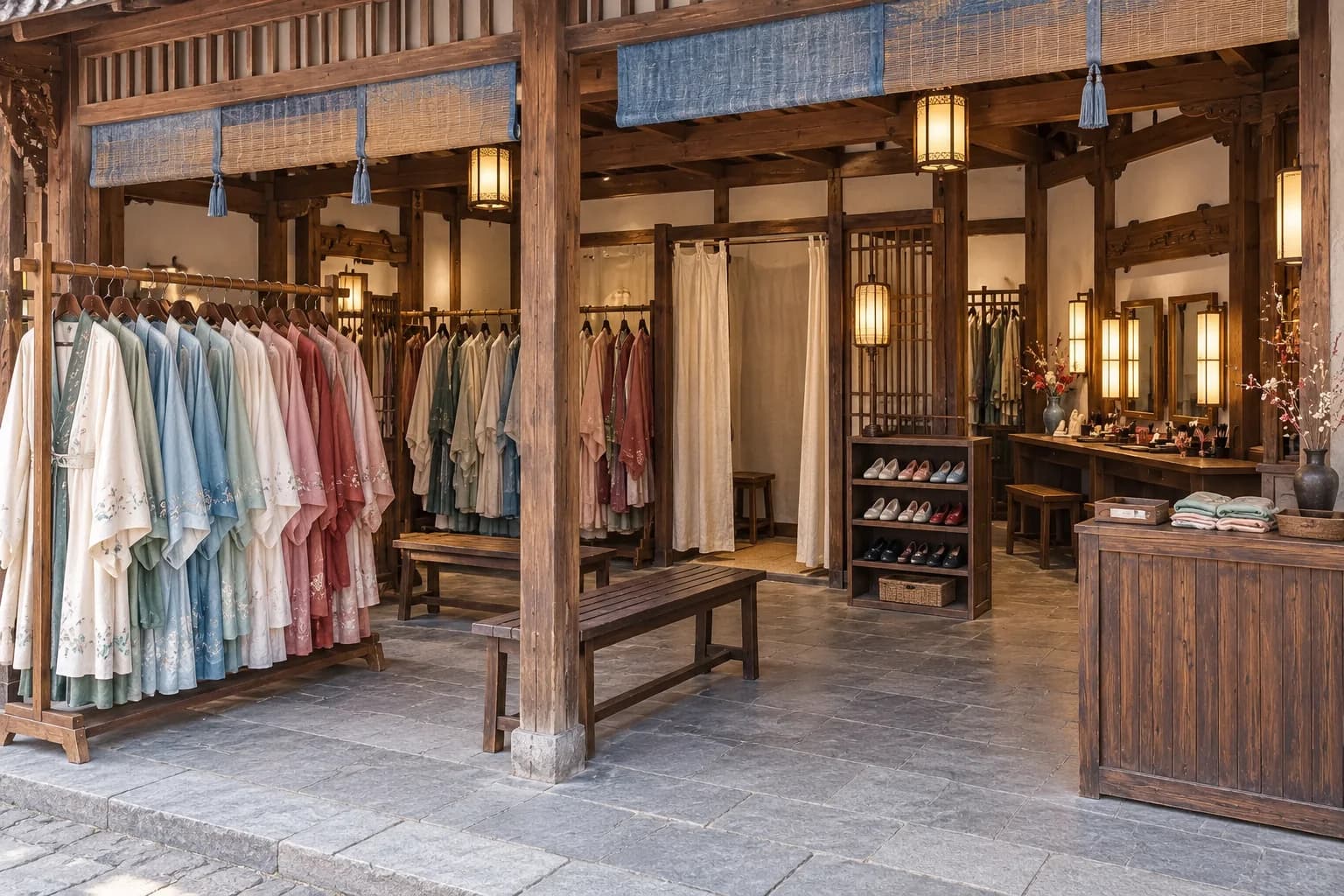
A good rental decision includes fitting, shoes, makeup, storage and return—not only the robe. This scene illustrates the workflow; verify the current vendor, hygiene, package and park permission in person.
For useful personal photographs, choose two short windows: quiet streets early and water or lantern light before full darkness. Photographing all day in long hems and unfamiliar shoes is a poor bargain. Keep normal shoes in a light bag, watch steps and bridges, and avoid dragging fabric near water, pyrotechnic zones or animals.
Children, older travelers and limited mobility
With children
Choose one “must-see” show and one flexible activity. Confirm sound, pyrotechnic, animal, height and age rules with staff; a martial-arts battle that looks exciting online can be loud at arena distance. Write a parent's Chinese mobile number on a card, photograph the child's clothing that morning and identify a staffed reunion point. Do not depend on a costume or character to keep a child engaged through a long queue.
Bring familiar snacks where park rules allow, sun protection, a layer for the evening and a small towel. Stroller users should expect bridges, thresholds and dense audiences. Ask about the accessible route rather than following a scenic shortcut.
With older travelers
Book the hotel for the tired version of the day. Cut the night show unless the group actively wants it. One seated headline performance, one scenic loop and a long lunch usually produce a better memory than five standing shows.
Ask guest services about mobility aids and accessible viewing before the programme fills. A flat map does not show bridge slopes, rough paving, standing queues or the distance from a stage to the vehicle pickup. Carry medicines in the day bag, not in luggage stored across town.
In rain or summer heat
Neither park becomes an indoor attraction because the weather is bad. Outdoor arenas, street interaction, boats, animals, lighting and pyrotechnic effects may change or stop. Waterproof the passport and phone, use shoes with grip and avoid long hems. In lightning, follow closures immediately.
In summer, treat 12:00–15:00 as a protected block. Eat early, use shade, refill water and choose a seated or covered element. Heat exhaustion is not cured by a misting fan. If a traveler becomes confused, stops sweating normally, develops severe headache or cannot keep fluids down, seek staff and medical help.
Food, crowds and the night exit
Park food is part of the performance environment, but it is a weak reason to lose an hour. At lunch, choose a clearly priced specialist counter, verify ingredients important to you and order conservatively. Viral snacks create queues because they are visible, not because they are the only good meal.
Carry water and a simple backup snack, subject to current entry rules. Travelers with allergies, halal requirements or vegetarian needs should show a written Chinese requirement and ask about broth, cooking oil and shared equipment. “No visible pork” or “vegetable” is not a complete ingredient check.
Holiday crowds change the day more than any route article can. Expect pressure at entry, the most famous show, dinner, toilets before a major performance and ride-hailing pickup after closing. The practical response is to keep only one fixed anchor, eat outside the peak, and choose a legal pickup point away from the gate crush only when the walking route is safe and well lit.
Where to stay, what to do with luggage and when to leave
Stay in Kaifeng for the night after a full park day. A Zhengzhou hotel plus a late show adds a long transfer precisely when queues and driver matching are least predictable. Compare current Kaifeng hotels on Trip.com, then verify late check-in, breakfast, luggage storage and the driving time to your chosen park.
Choose the base by the second morning:
- Old-city base: best when Day 1 or Day 2 includes Dragon Pavilion, Kaifeng Prefecture, temples, the Guild Hall or a night market.
- Park-side base: useful when an early gate, late show or a child makes the shortest possible return more valuable than city-center dining.
- Station-oriented base: sensible only when an early train controls the next day; it is less useful for a late park exit followed by another cross-city transfer.
Leave large luggage with the hotel or a verified staffed facility. Do not assume every park gate accepts oversized cases, operates storage until your show ends or lets you return to the same gate after a night programme. Photograph the claim ticket and closing time.
If you must take a train after the park, work backward from the train's boarding cutoff, not departure time. Add exit crowd, pickup, road delay, station security and platform access. A same-night Zhengzhou connection after a headline show needs a large buffer and a fallback; the more robust plan is a Kaifeng hotel.
What to cut first
- One day in Kaifeng: cut Wansui and use Qingming Riverside only if immersive entertainment is your top priority; otherwise cut both parks and take the museum-plus-monuments route.
- Two days: keep one park and one history day. Cut the second park.
- Rain: cut uncovered headline shows first, then reassess whether the remaining indoor/covered programme justifies the ticket.
- A tired mixed-age group: cut the late show before cutting the midday rest.
- A failed Wansui reservation: keep the park only if the alternative live programme still appeals. Do not buy an unofficial slot.
- A sold-out Qingming night show: keep the daytime park if the river-and-street experience is your goal; otherwise move the large spectacle to another date rather than buying an unclear resale product.
The useful Kaifeng trip is not the one with the most performances. It is the one that separates evidence from interpretation, chooses one entertainment world deliberately, and leaves enough energy to understand the city outside the gates.