Jilin City and its winter rime
Updated October 29, 2026
Jilin City (吉林市, Jílín Shì) has a winter sight found almost nowhere else. On the coldest mornings, every willow along the Songhua River turns white with rime (雾凇, wùsōng), feathery ice crystals that grow on branches overnight. The reason is the Fengman Dam upstream. Water released from the reservoir keeps the river unfrozen even when the air falls below −20 °C. Vapor rises off the open water as mist, drifts into the trees and freezes on contact.
On a good day the riverbank looks like a forest made of frost. By mid-morning the sun loosens the crystals and they fall like snow. Rime is therefore a dawn event that needs the right weather. If it's the main reason you're coming, plan for two or three mornings, and fill the rest with the city's museum, old churches, morning markets, Manchu hot pot and two ski resorts within an hour.
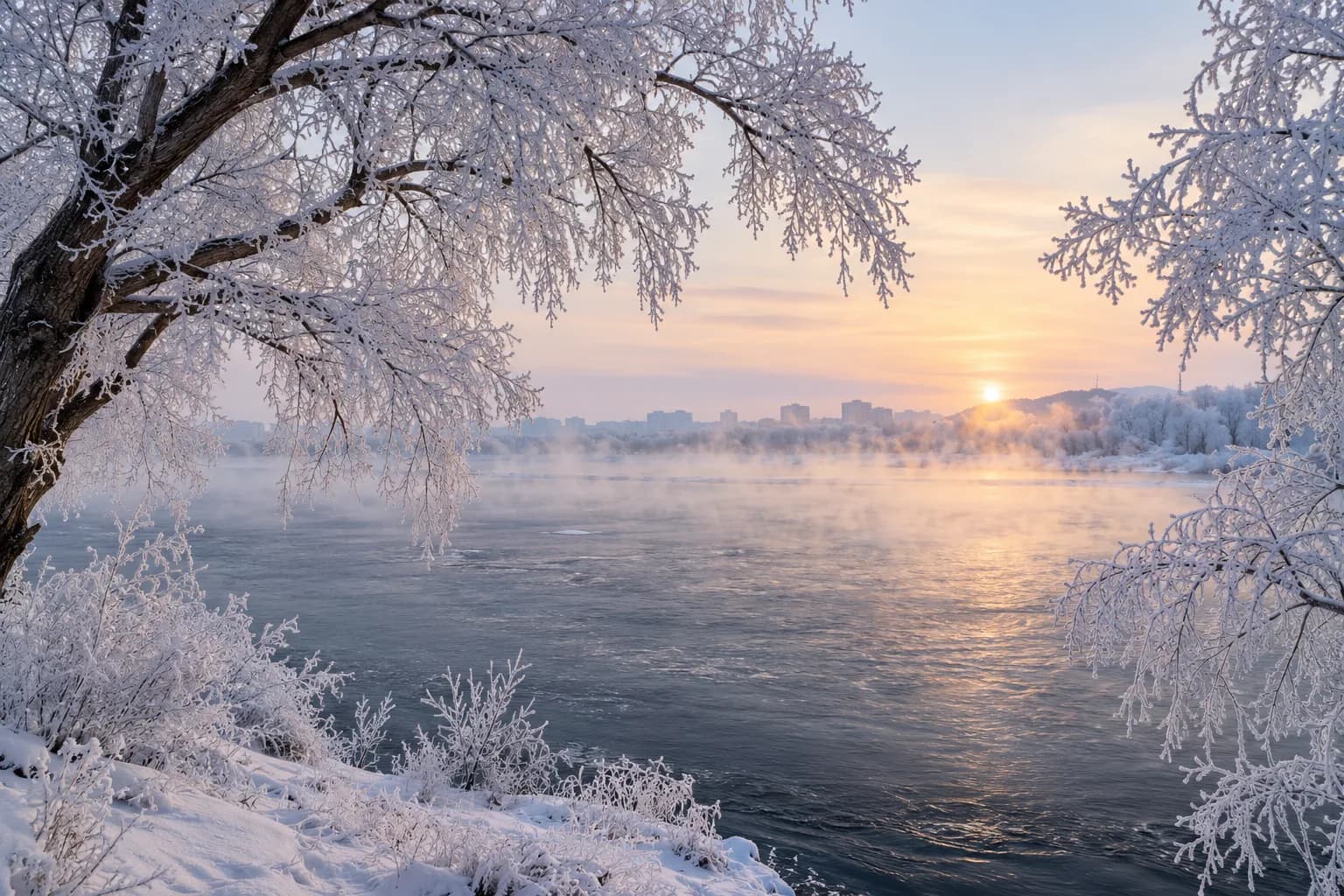
When rime forms
- Season: It can form from late November to mid-February. Strong rime is most common from early January to early February, and five-star mornings cluster in late January and early February. In 2025 the season's first widely reported large rime, at Ashi, came on 28 November.
- Conditions: It needs a very cold night (local trackers look for about −20 °C to −26 °C), plenty of river mist and little wind. A clear, still morning after a frigid night is ideal. A sunny day alone does not guarantee rime.
- Time of day:
- Sunrise to about 08:30: River mist and soft light. This is atmospheric, but the trees can be grey in photos.
- About 08:30–09:30: Blue sky behind fully coated branches, the most photogenic window.
- After about 09:30–10:00: Warming sun and wind start dropping the crystals, on cold windless days somewhat later.
Read the morning star forecast
Every winter, Jilin City's tourism authority runs a rime forecast covering 17 points along 11 viewing belts. For about 100 days from mid- or late November to mid-February, it publishes a daily rime morning report (雾凇晨报) on the city's official tourism WeChat channels, roughly 05:00–06:00. Search for 吉林雾凇 or 吉林市行. Each site gets a star rating:
- No stars: You are unlikely to see rime.
- Three stars: Worth going.
- Four or five stars: Exceptional. Go now.
Set an alarm for about 05:30, check the report, then choose the site. Local livestreams from the riverbank are a useful second check. A cold forecast the night before is not enough to commit to a long rural transfer.
Where to see it
One local rime tracker logged the daily forecast across a full season. The results show why the closest major site is usually the best bet:
| Viewing area | Distance from the city | Days with 3★ or better | Notes |
|---|---|---|---|
| Ashihada / Ashi Little Rime Island (阿什哈达 · 阿什小雾凇岛) | ~11 km, 20–30 minutes by car | 51 | The most reliable site. It reached five stars, often in early February. Free; roadside parking about ¥10 |
| Baishan Lake (白山湖) | ~150 km | 35 | Too far for a dawn decision |
| Hongshi Lake (红石湖) | ~110 km | 34 | Mostly one- and two-star |
| Beidahu ski area (北大湖) | ~53 km | 29 | Rime on the trees most ski days |
| Vanke Songhua Lake ski resort (万科松花湖) | ~10 km | 28 | Easy rime to combine with skiing |
| Wusong Island / Hantun (雾凇岛 · 韩屯) | ~35–40 km | 26 | Five-star days cluster in late January and early February; mostly one or two stars at other times |
| Jiangbin Park (江滨公园), city center | In town | 11 | A convenient fallback |
| Songjiang Road (松江路), city center | In town | 6 | Seldom strong, but good for river mist |
Ashi Little Rime Island: the default choice
The willows along Jifeng East Road (吉丰东路) on the Fengman side of the river form a long riverside rime corridor. Locals call the best stretch 万缕银丝, "ten thousand silver threads". The crowd gathers near the entrance; walk further along the bank and it thins out. Bus 33 from Jilin Station (¥2) and tourist line 333 (¥6) both stop at the Ashihada belt. On festival mornings the city has also run free rime shuttles from points around town.
The common problem is getting back. On a good morning, traffic jams on the way in, and after 09:30 taxis are hard to find. Arrange your return before you go or budget time for a long walk to a bus stop.
Wusong Island (Hantun): for the rural dawn
Rime Island sits in the Songhua River near Wulajie (乌拉街), with the villages of Hantun (韩屯) and Zengtongtun (曾通屯) on its banks. At its best in late January and early February it is the classic picture: farmhouses, a frozen landscape and a whole island of white trees. Recent reports give an entry fee of about ¥60 and winter opening of roughly 06:10–13:50. Village homestays let you walk to the bank at 06:30 instead of driving 40 km in the dark. Before booking, ask whether the room has a heated kang bed or radiators, and whether there is hot water.
Go there only when the forecast shows four or five stars for the island, or when you are staying in the village anyway. Otherwise you may arrive after a long transfer to grey trees while Ashi is white.
Rime Island tickets and transfers on Trip.com
Stay in the city or on the island?
- Stay in the city (near Jilin Station or in Fengman district) if you also want the city's sights or are traveling with children or older relatives. It also lets you pick the site each morning from the forecast. Fengman is only 15–20 minutes by taxi from Ashi.
- Stay at Hantun for one night if rime photography is the whole point of your trip and your dates fall in late January or early February.
A three-day winter plan
Day 1: arrive and see the old city
Take the train to Jilin Station. The city's main museum is free and houses the Jilin meteorite, the largest stony meteorite fragment ever found, which fell in a meteor shower over the city in 1976. Reserve a day ahead; in recent seasons there has also been a walk-in window around 11:30–13:00. Walk to the Gothic Catholic Church (天主教堂) beside the river, which visitors can usually enter. For dinner, try Manchu hot pot (乌拉满族火锅): a charcoal copper pot of sour pickled cabbage, thin-sliced meat and blood sausage.
Day 2: first rime morning, then ski or hills
Check the 05:30 forecast. If Ashi shows three stars or more, be on the bank by about 07:00 and stay until the crystals fall. On a weak morning, go instead to the Beishan morning market (北山早市) at about 06:30, then climb Beishan Park's temples above the city. In the afternoon, ski at Vanke Songhua Lake, 10 km away. Day passes there end around 16:00, so go after lunch, not late afternoon. Beginners may be happier at an indoor or city slope first.
Day 3: second chance
Check the forecast again. Go back to Ashi, or head to Wusong Island if it shows four or five stars and you have arranged transport. On a clear evening, Xuantianling (玄天岭) is a good sunset viewpoint; arrive around 16:00. Huichun Street morning market (珲春街早市) is another early start, for hot breakfast snacks among local shoppers. For steamed dumplings, the long-established Xinxingyuan (新兴园) is a local favorite; eat them whole, since they are full of hot broth.
Cold, camera and conduct
- Dress for −20 °C on the riverbank: a long down coat, windproof trousers, insulated snow boots, a hat covering your ears, a scarf and two pairs of gloves. Stick warming patches on your phone and spare batteries, which can shut down within minutes.
- Protect your camera: Before entering a heated room, seal the camera in a plastic bag so condensation forms on the bag instead of inside the lens.
- Skip the animal photo stalls: Stalls near the entrances charge around ¥10 for photos with white foxes. Visitors have reported that the animals are sedated and have had their teeth pulled.
- Use caution with other stalls: Treat the private horse, sled and "boiling water into ice" stalls with caution. They are unregulated, and paid photographers often shoot poorly into the sun. If you want the effect, throw the water yourself, away from other people.
- Take care on the roads: Roads are icy and some drivers go fast. Cross carefully, even at crossings.
Getting there and onward
- From Changchun: The intercity high-speed line takes about 30–40 minutes. It also serves Changchun Longjia Airport, which has had a seasonal direct bus to Wusong Island for about ¥25.
- Onward east: High-speed trains continue toward Yanji and the Changbai Mountain area in around two hours.
- On the northeast circuit: Jilin City makes an easy two- or three-night stop between Harbin and Changbai Mountain.
Continue to Yanji for Korean-Chinese food culture and Changbai Mountain for Tianchi crater lake. To fit Jilin City into the 10-day Northeast winter route, add two nights rather than replacing the Changbaishan weather day.