Yunnan route chooser: 7, 10 or 14 days
Yunnan is not one sightseeing loop. It is a province of separate travel corridors divided by highlands, river valleys and long final approaches. The famous Kunming–Dali–Lijiang sequence is practical because rail joins the bases in one direction. Shangri-La continues that sequence north, but raises both altitude and weather exposure. Tengchong sits on a western branch. Jianshui and Yuanyang form a south-eastern heritage-and-terrace journey. Xishuangbanna is a tropical southern trip with Jinghong as its base.
That geography explains why a route that looks impressive in a social post can feel mostly like packing. Seven days can support one corridor. Ten days can support the classic north-west line with Shangri-La, or one slower branch. Fourteen days can join two corridors if one transfer is treated as a real day. It still cannot cover every headline region well.
Use this guide to choose the province-level shape. Then use the linked city and itinerary guides for daily attraction order, tickets and current local transport.
The quick route chooser
| Route | What it is best for | Transport shape | Comfortable minimum | Hotel bases | Main reason to cut it |
|---|---|---|---|---|---|
| Kunming → Dali → Lijiang | First visit, rail simplicity, old towns, lake basin and one mountain day | One north-west rail line, then local transfers | 7 days without Shangri-La; 9–10 with it | 3, or 4 with Shangri-La | You want tropical nature, terrace photography or one quiet base |
| Add Shangri-La | Tibetan cultural context, highland landscape and a clear altitude progression | Continue north by rail from Lijiang | 3 nights inside a wider route | Adds 1 | Anyone should avoid a roughly 3,200-metre sleeping altitude or the trip has no weather margin |
| Tengchong | Heshun, war history, managed geothermal landscape and a slow western base | Usually flight or long westward surface transfer; local road days | 4 full days, plus access | 1 | You are adding it as a one-night detour from Dali |
| Jianshui and Yuanyang | Courtyard heritage, railway history, working rice terraces and photography | Rail to Jianshui, then a committed road transfer to Yuanyang | 4–5 days | 2 | You need door-to-door rail or a guaranteed mirror-like terrace view |
| Xishuangbanna | Tropical plants, Dai and Theravada cultural context, rainforest interpretation | Southbound rail or flight to Jinghong, then separate outward road days | 4 days | 1 | You expect it to be a quick continuation from Lijiang or Shangri-La |
The best first route is the one whose transfer shape matches the group. Rail travellers usually start with the north-west corridor. Slow travellers can choose Tengchong alone. Photographers who accept cloud and field-condition risk may prefer Jianshui–Yuanyang. Families interested in plants and wildlife interpretation can use one Jinghong base, while treating any wild-animal sighting as a bonus.
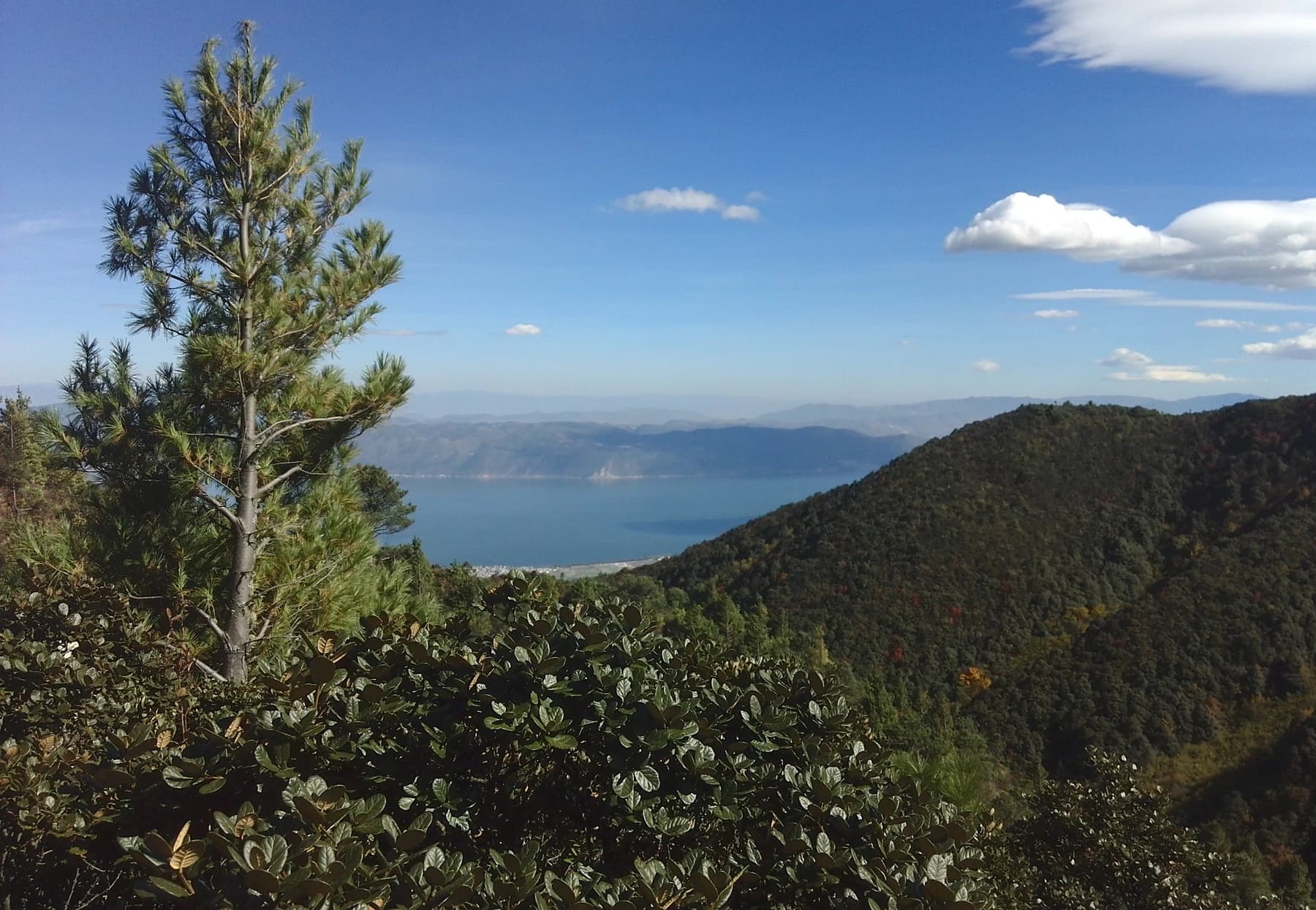
Photo: Toni Wöhrl · Source · CC BY-SA 4.0
Cangshan and Erhai show why Dali deserves time as a basin rather than a photographed overnight stop. Mountain visibility and cableway operation remain weather-dependent. Photo by Toni Wöhrl, CC BY-SA 4.0.
Understand the five route geometries
1. The north-west rail ladder
Kunming, Dali, Lijiang and Shangri-La form the only obvious first-trip ladder in this guide. Each move advances in the same direction. The official railway opening announcement gave fastest examples of about 4 hours 30 minutes from Kunming to Shangri-La, 3 hours 58 minutes from Dali and 1 hour 18 minutes from Lijiang when the line opened in 2023. A 2026 provincial transport update reported that peak service had grown, with the fastest Lijiang–Shangri-La journey around 1 hour 10 minutes. These are network examples, not a promise that the right train runs on your date.
Station names also hide the final mile. Kunming South Station is in Chenggong, away from central Kunming. Dali Station is in Xiaguan, not Dali Old Town. Lijiang Station still requires a transfer to Dayan, Shuhe or Baisha. Shangri-La Station does not turn the first high-altitude afternoon into a sightseeing race.
Budget about half a day for a hotel-to-hotel rail move after checkout, road access, security, boarding, station exit and the next hotel. That rule matters more than the scheduled ride time.
2. The western branch: Tengchong
Tengchong works as a destination, not a side trip. Tuofeng Airport gives it an air gateway, but routes and frequencies are date-specific. Surface access from Dali or Kunming belongs in a live transport search, and a long coach or rail-plus-road day should not be followed by a paid attraction.
Once there, the geometry becomes easier: one Tengchong or Heshun-edge base can support the memorial and museum, Heshun, Rehai and Beihai Wetland on separate days. The four-day Tengchong plan is the useful unit. If your draft allocates one night, remove Tengchong instead of pretending the access day is the experience.
3. The south-eastern fork: Jianshui and Yuanyang
Rail solves the first leg to Jianshui Station. It does not solve the whole journey. Yuanyang's terrace villages are reached by road, and “Yuanyang” can refer to the county seat, old Xinjie or a village near a particular viewing area. Book the final road transfer and the exact hotel location together.
The strongest structure is two nights in Jianshui and at least one or two nights near the terrace zone. This protects the heritage town from becoming a lunch stop and gives the landscape more than one weather window. The four-day Jianshui–Yuanyang itinerary uses that logic.
4. The tropical south: Xishuangbanna
The China–Laos Railway runs south from Kunming through Pu'er to Xishuangbanna. That makes Xishuangbanna Station a real rail option, but it does not make Jinghong adjacent to north-west Yunnan. From Lijiang or Shangri-La, compare a flight connection with the time and risk of returning through Kunming. Direct air service may be seasonal or non-daily, so never build a non-refundable chain around an assumed route.
Use Jinghong for one city-and-temple day, then give the tropical botanical garden, Wild Elephant Valley or Dai Garden separate outward days. The four-day Xishuangbanna plan is already full without adding another city.
5. Kunming as hinge, not compulsory sightseeing
Kunming connects the rail branches and holds the widest air choice. That does not mean every route needs two full sightseeing days there. On a seven-day north-west trip, Kunming may be only the safe arrival night. On a Honghe route it is the logical rail hinge. Between distant branches it may be a necessary buffer night.
Keep the distinction clear: a Kunming buffer protects a flight or train connection; a Kunming stay earns time for Green Lake, the provincial museum, Dianchi or one karst excursion. Do not label a late arrival and early departure as “two days in Kunming.”
Seven days: choose one corridor
Seven days usually means six nights. Three hotel bases are already a meaningful luggage load.
The balanced first route: Kunming, Dali and Lijiang
- Day 1: arrive Kunming; sleep there if the onward connection is not comfortably protected.
- Days 2–3: Dali, with one basin or village day and one old-town/Cangshan choice.
- Days 4–6: Lijiang, with one old-town-area day, one weather-dependent mountain day and one slower Baisha/Shuhe or recovery block.
- Day 7: depart from Lijiang if the air or rail connection works; otherwise return toward Kunming with a real buffer.
This allocates one Kunming night, two Dali nights and three Lijiang nights. If the international or domestic arrival lands early enough for a protected same-day train, put that Kunming night into Dali. Do not pre-buy a tight self-connection after a flight.
The highland version: Dali, Lijiang and Shangri-La
This is viable only when you can arrive into Dali or move beyond Kunming without strain, and leave from Shangri-La or accept a final rail return. Use two nights in each base. Cut Kunming sightseeing, Jade Dragon Snow Mountain or a Dali lake-shore day according to priorities; do not squeeze all three back in.
Shangri-La is the first cut when anyone has a relevant health concern, reacts poorly to altitude or needs a low-effort trip. It is also the wrong two-night add-on after a delayed arrival: one night does not create an acclimatization plan.
Three focused seven-day alternatives
- Kunming + Tengchong: use the gateway and access days honestly, then keep four complete Tengchong days. Best for a single-base pace and history.
- Kunming + Jianshui + Yuanyang: two Kunming nights around a four-day Honghe route. Best for heritage and photography, provided the road transfer is acceptable.
- Kunming + Xishuangbanna: one arrival/buffer night plus four or five Jinghong-based days. Best for tropical ecology, families and travellers avoiding repeated hotel changes.
These are not lesser substitutes for the classic route. They are different trips with cleaner execution.
Ten days: add depth or one altitude step
Ten days and nine nights is the first length that supports all four north-west bases without turning every station into the main memory.
Recommended first-time north-west plan
- Night 1: Kunming. Recover from arrival and protect the first rail connection.
- Nights 2–3: Dali. Choose the west-shore villages or the east shore, not an exhausting whole-lake circuit.
- Nights 4–6: Lijiang. Give weather-sensitive Jade Dragon its own day and keep the old towns separate.
- Nights 7–9: Shangri-La. Arrive gently, then choose Sumtseling/Napa and Pudacuo on different days.
- Day 10: leave from Shangri-La when the schedule is sensible, or start a protected return.
The count is 1 + 2 + 3 + 3 = 9 nights. It has four bases and three intercity transfers. The three-day Shangri-La plan is a better finish than adding Tiger Leaping Gorge, Meili Snow Mountain and another one-night hotel.
If Dali's lake basin matters more than a second Lijiang old-town day, use three nights in Dali and two in Lijiang. If altitude is uncertain, remove Shangri-La and distribute those nights across Kunming, Dali and Lijiang. That is a stronger trip, not a failed itinerary.
Better ten-day alternatives
- Tengchong + Dali: four Tengchong nights, three Dali nights and access/buffer nights. This is a western history-and-landscape trip, but verify the actual link between the two on your dates.
- Kunming + Honghe: two Kunming nights, two Jianshui nights, two Yuanyang nights and a slower Mengzi or Mile chapter. This reduces altitude load but increases road dependence.
- Kunming + Xishuangbanna: two or three Kunming nights plus five Jinghong nights. Add a spare weather block rather than a one-night Pu'er or border detour.
Fourteen days: join two corridors, not the whole province
Fourteen days and thirteen nights can support two contrasting regions. The joining day is a transfer day even when a flight looks short.
North-west plus tropical south
Use about nine nights for Kunming, Dali, Lijiang and Shangri-La, then four nights in Jinghong. The tenth day becomes the connection south, possibly through Kunming. If there is a convenient direct flight on your date, treat it as a bonus; do not assume it when designing the trip months ahead.
This combination has the strongest environmental contrast, but also the biggest packing problem: cold highland mornings and warm, humid tropical days. It suits travellers who want two distinct chapters more than slow travel.
North-west plus Honghe
Keep Kunming, Dali and Lijiang to roughly eight or nine nights. Return through Kunming and give Jianshui–Yuanyang four or five nights. Cut Shangri-La first: north to Shangri-La and then south-east to Yuanyang adds a high-altitude branch followed by a long reversal.
This is the best two-week choice for architecture and photography. It is less convenient for anyone who wants elevators, door-to-door rail or a single hotel.
Dali plus Tengchong
Use Dali as the eastern chapter and Tengchong as the western chapter, with a transport and weather buffer around the connection. It gives more time in lived-in places and fewer headline bases than the classic route. It also avoids the highest sleeping altitude. Choose it for slower travel, borderland history, village texture and managed geothermal landscapes.
A southern route with no north-west checklist
Kunming, Jianshui–Yuanyang and Xishuangbanna can form a coherent south-facing trip if the rail and road legs work on your dates. Allocate two or three nights to Kunming, four or five to Honghe, a full connection day and four or five to Jinghong. Do not insert Dali merely because it appears on every first-time list.
Altitude: use the route as a staircase, not protection
Approximate city-floor elevations explain the north-west sequence: central Kunming is about 1,891 metres, Lijiang Old Town about 2,400 metres, and central Shangri-La roughly 3,200 metres. Dali lies between Kunming and Lijiang in the Erhai basin. Scenic products can go much higher than the hotel.
The sequence Kunming → Dali → Lijiang → Shangri-La is a sensible gradual rise. It does not guarantee acclimatization or prevent altitude illness. Keep the first Shangri-La afternoon light, avoid turning arrival into an uphill old-town race, and do not schedule the hardest mountain outing immediately after a low-altitude flight. Travellers with relevant heart, lung, pregnancy or other medical concerns should seek individual clinical advice before booking. If symptoms worsen or occur at rest, stop ascending and seek urgent medical assessment rather than relying on oxygen cans or online remedies.
Families and older travellers should choose according to the least altitude-tolerant person. Dali and Lijiang still involve stone lanes, steps and vehicle drop-offs away from old-town hotels. A lower route is not automatically step-free.
Seasons: choose a pattern, never a promised scene
Yunnan holds several climates at once. A province-wide weather icon is almost useless.
- North-west highlands: spring and autumn often offer workable touring conditions, while summer falls within the wetter period and winter brings colder nights and possible mountain disruption. Snow-capped peaks, open cableways and clear views are never guaranteed.
- Yuanyang: the terraces are a working agricultural system. Water-filled winter or spring fields, green growing-season terraces, harvest colours, cloud and fog produce different views. Confirm recent field and weather conditions; a reflective sunrise is not an admission benefit.
- Tengchong: rain affects roads and wetland conditions. Ginkgo colour is short, weather-dependent and crowded; do not build a whole route around an assumed week.
- Xishuangbanna: tropical heat, humidity, heavy rain and strong sun change the walking load. Put the major outward day early and keep one flexible block.
- Flowers and festivals: blossom dates, village celebrations and market rhythms are living seasonal events. Use an official dated announcement close to travel instead of copying last year's calendar.

Photo: Takeaway · Source · CC BY-SA 3.0
Water-filled terraces are one seasonal expression of Yuanyang's forest–water–village–terrace system. Field water, cloud and visibility change; book for the cultural landscape, not this exact reflection. Photo by Takeaway, CC BY-SA 3.0.
Choose by traveller, not popularity
First independent trip
Choose Kunming–Dali–Lijiang. Rail removes the hardest intercity decisions, English-language booking support is stronger and bad weather leaves cultural alternatives. Add Shangri-La only with ten days and a realistic altitude plan.
Family with children
Choose two or three bases, not four. Dali gives open space but requires careful lake-shore transport. Xishuangbanna offers plants and wildlife interpretation from one Jinghong base, though outward days are long and heat matters. Never promise a wild elephant sighting. For toddlers, old-town paving and hotels beyond vehicle access can be more disruptive than the train itself.
Photography-first trip
Jianshui–Yuanyang offers the strongest purpose-built branch, but the correct price of that choice is road access, early starts and weather uncertainty. Lijiang and Shangri-La offer greater mountain scale with higher altitude and operating risk. Carry a flexible shot list; do not trespass into fields, village homes, religious spaces or closed mountain paths for a frame.
Culture-first trip
Choose fewer communities and spend longer. Dali's Bai villages, Lijiang's Naxi heritage, Shangri-La's Tibetan Buddhist institutions, Honghe's Hani cultural landscape and Xishuangbanna's Dai and Theravada contexts are not interchangeable “ethnic photo stops.” Use museums, community-led interpretation and active places of worship respectfully. Ask before photographing people, ceremonies or private homes; costume commerce is not a substitute for cultural context.
Slow travel or limited energy
Choose Tengchong or Dali as one primary base. Both still need vehicles for outward days, but they avoid changing hotels every two nights. In Dali, stay near the old-town edge or Xiaguan according to actual priorities. In Tengchong, compare practical city access with the slopes and vehicle restrictions of a Heshun stay.
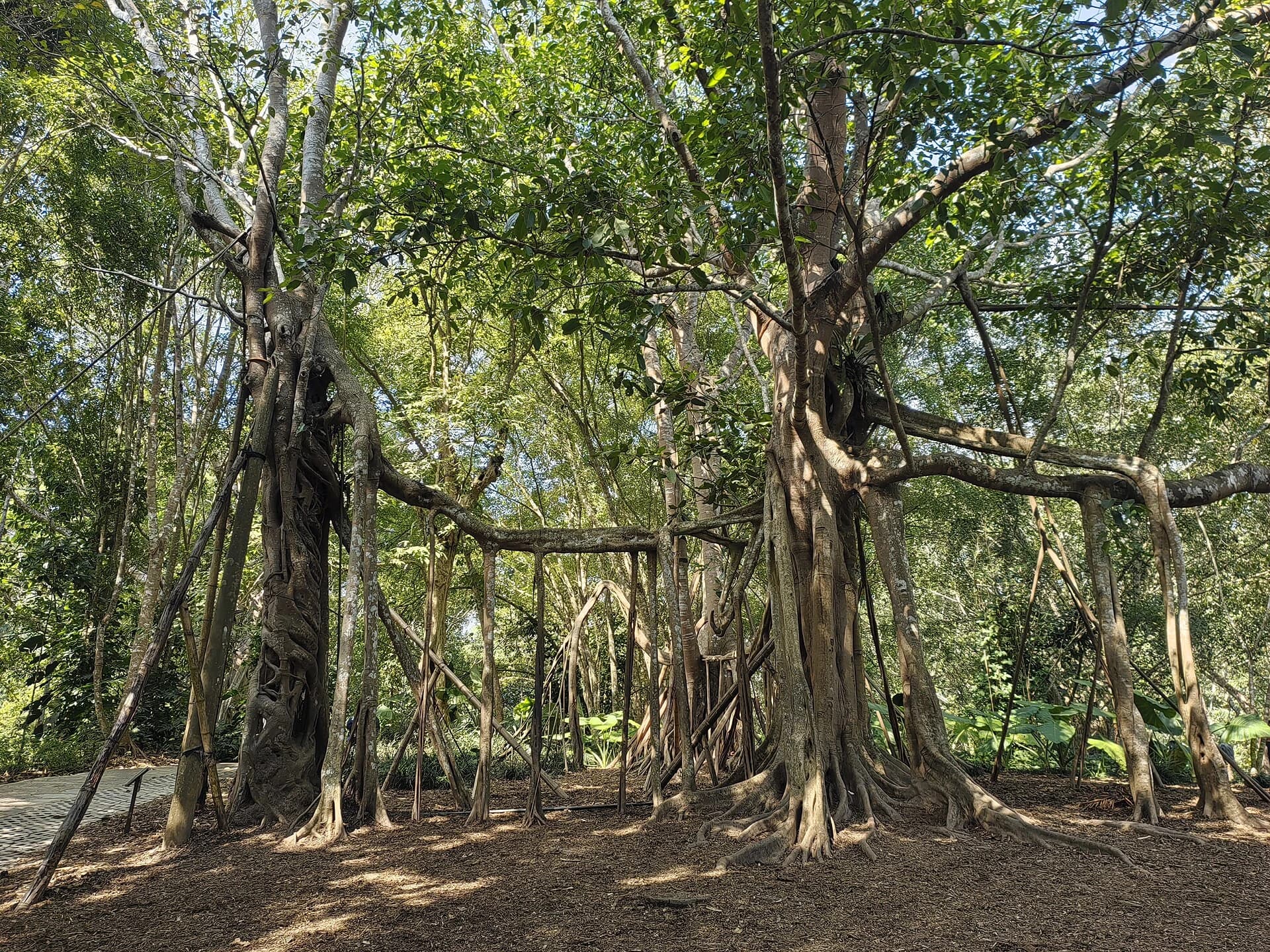
Photo: Yumeto · Source · CC BY-SA 4.0
The tropical botanical garden gives Xishuangbanna a clear purpose beyond a night-market stop. Give its living collections and rainforest sector a full day, with current vehicle and open-area checks. Photo by Yumeto, CC BY-SA 4.0.
Hotel changes and luggage rules
Count bases, not city names. A two-night base gives only one full day. A one-night base is usually an evening, a sleep and another packing session.
- Keep seven days to no more than three bases.
- Keep ten days to four bases only when they sit on one rail line.
- Use two corridors in fourteen days; give the joining transfer its own day.
- Choose old-town lodging by vehicle drop-off, stairs and walking surface before choosing a romantic courtyard.
- Send large luggage only through a service whose timing, insurance, receiving address and prohibited-item rules you understand. Do not assume every small hotel can receive it.
- Keep passport, medicine, batteries and one change of clothes with you on every transfer.
Open-jaw tickets can remove a backtrack. Arrive in Kunming and leave from Lijiang, Shangri-La, Tengchong or Jinghong when an acceptable flight exists. Compare the fare with the saved hotel and transfer day. A cheap round trip to Kunming may cost more after the final reversal.
What to cut first
- Seven days, four north-west cities: cut Shangri-La or cut Kunming sightseeing. Do not reduce every base to one night.
- North-west plus Xishuangbanna in ten days: choose one. The tropical branch needs four useful days after access.
- Dali plus Tengchong as a day trip: remove Tengchong and keep Dali, or rebuild the holiday around four Tengchong days.
- Jianshui, Yuanyang and Xishuangbanna in one week: choose Honghe for heritage/photography or Xishuangbanna for tropical ecology.
- Shangri-La plus Yuanyang: cut the weaker personal priority. They sit on opposite branches and create an altitude jump followed by a long reversal.
- A viral road loop with one night everywhere: cut every stop that does not earn at least one full day. A local driver's long-distance circuit is not automatically an independent rail itinerary.
When weather closes a mountain product, replace the activity rather than the city. Lijiang can shift to Baisha, Shuhe or cultural interiors. Shangri-La can use a light Dukezong or museum block if health allows. Yuanyang can still be culturally meaningful without a perfect sunrise, but travellers whose only goal is the reflected view should delay rather than force it.
Book in the right order
- International and open-jaw geometry. Decide whether the trip can end outside Kunming.
- The hardest intercity leg. Check dated rail and flight inventory, including the exact station or airport.
- Altitude and weather-sensitive anchor. Reserve only after reading current operating and cancellation terms.
- Vehicle-accessible hotels. Verify the exact map pin, passport acceptance, heating or cooling, stairs and luggage approach.
- Rural return transport. Yuanyang, Xishuangbanna outward sites and Tengchong excursions need a written return plan.
Check current China train inventory on Trip.com and compare flights only after fixing the route shape. For accommodation, use the exact city search where available: Lijiang, Shangri-La, Tengchong, Jianshui or Xishuangbanna. A bookable listing does not confirm today's scenic operation, a direct transfer or a foreign-passport ticket path.
Final route test
Before paying, write the itinerary as nights and door-to-door moves. Circle every day that includes checkout. If more than one third of the trip is circled, cut a base. Mark each weather-dependent attraction and ensure the following morning is not an irreplaceable flight. Mark the highest sleeping altitude and make sure the route rises deliberately.
Then ask one question: if the signature mountain, terrace reflection, flower field or animal sighting does not appear, does the route still have a reason to exist? A strong Yunnan itinerary answers yes.