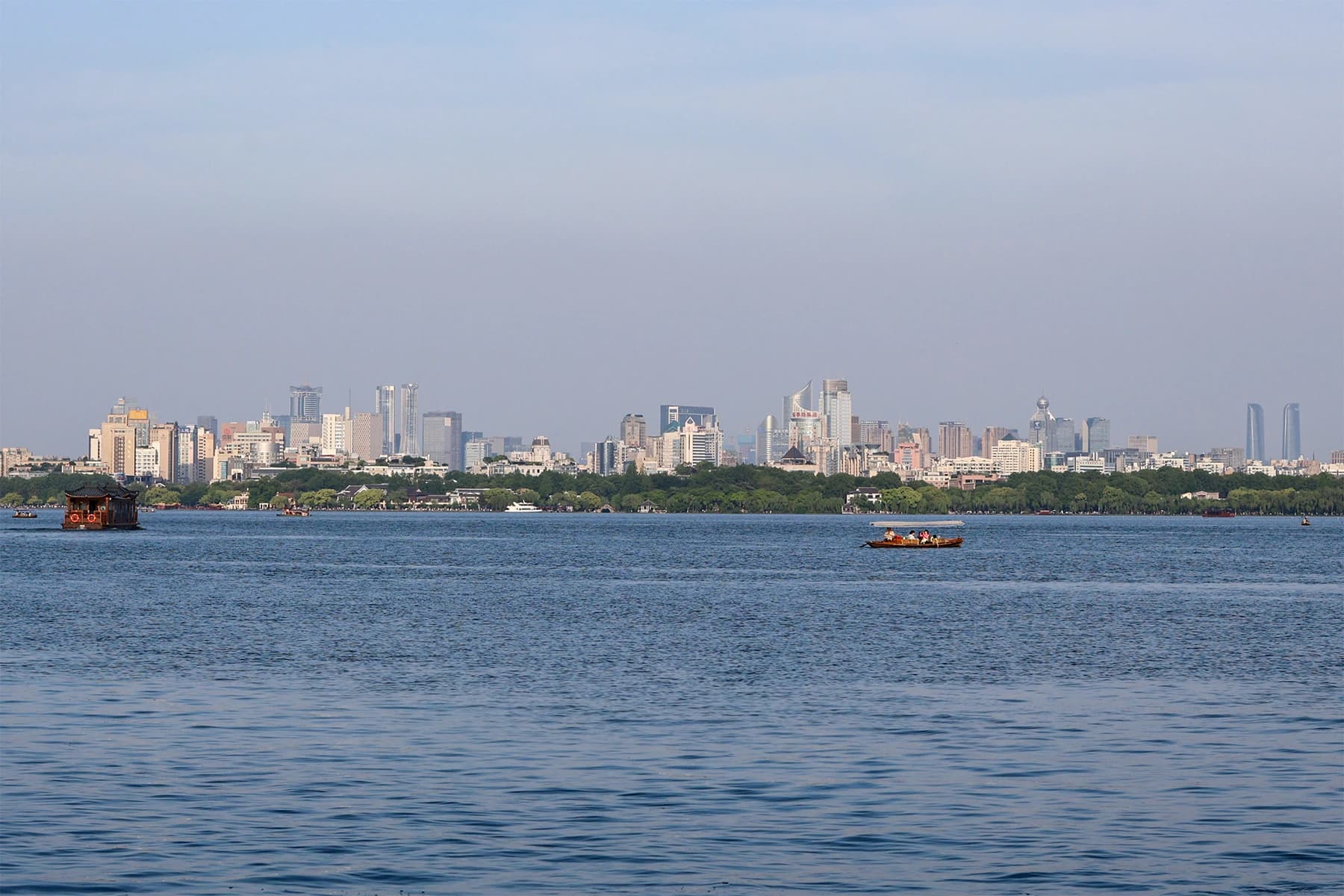
Hangzhou or Suzhou?
Choose Hangzhou for lake, hills, temples, tea and a larger modern city wrapped around landscape. Choose Suzhou for classical gardens, canals, compact old-city walks and a more concentrated Jiangnan architecture chapter.
Decision table
| Priority | Hangzhou | Suzhou |
|---|---|---|
| Signature | West Lake landscape | classical private gardens |
| Best first stay | 2–3 nights | 2 nights |
| One-day focus | one lake shore + temple/old city | one major + one small garden + canal street |
| Physical feel | longer open-air distances and hills | smaller sites but repeated walking/queues |
| Rain fallback | museums, tea, old city | gardens remain atmospheric; museums/embroidery |
| From Shanghai | better as overnight | easier day trip, better with one night |
Why Hangzhou needs restraint
West Lake is not one attraction to “complete.” Pick one shore and one secondary theme. A useful day might combine the eastern/southern waterfront with old-city streets, or Lingyin/Feilai Peak with a tea-area stop. Trying to circle the lake, visit Lingyin and add modern Hangzhou creates a transport day.
Hangzhou suits travelers who like open landscape and a contemporary city. It also offers more variety over three days, but peak traffic around the lake can make road transfers unreliable.
Why Suzhou needs depth
Suzhou is not “just gardens.” The point is to compare spatial ideas: borrowed views, rockery, water, framed windows and seasonal planting. Choose one major garden at opening, then a smaller garden, museum or canal walk. Four famous gardens in a day become repetitive and exhausting.
Suzhou often surprises visitors who planned only a day; evening canals, food and a quiet morning justify one night. Yet it is easier than Hangzhou as a Shanghai day trip when the route stays compact.
A realistic day in each
Hangzhou: one West Lake loop without backtracking
A low-effort loop that mixes the lakeside cart and a boat:
- Willow Waves (柳浪闻莺)
- Lakeside sightseeing cart to Leifeng Pagoda
- Jingci Temple, much quieter than Lingyin
- Boat to Three Pools Mirroring the Moon (三潭印月), the scene on the back of the ¥1 note
- Leave the island on the boat to the Huagang Guanyu pier
- Walk on to Quyuan Fenghe and the Broken Bridge
The ¥70 combined boat ticket covers the trip to the island, landing and the onward boat. Choosing the Huagang pier for the second leg is what avoids walking back.
A family-friendly alternative.
- Start from Fengqi Road metro exit F, which avoids the Longxiangqiao crowds.
- Walk the Broken Bridge, the Bai Causeway and Pinghu Qiuyue.
- Continue to Quyuan Fenghe and Huagang Guanyu, where children can feed the carp.
- Finish with a hand-rowed boat on the quieter Wuguitan route.
The boatmen mostly stop taking that route after about 15:00.
Getting there. Parking around the lake is very difficult, and odd–even plate restrictions apply on weekends and holidays. Use the metro or bus.
Suzhou: one major garden at opening, then smaller ones
Humble Administrator's Garden (拙政园).
- Booking: tickets are sold only by real-name booking on the official Suzhou Gardens platform, up to seven days ahead, with tickets released at midnight. There is no ticket office on site. Once booked, you can enter any time that day before last entry.
- Price: ¥80 in peak season (April–May, July–October) and ¥70 otherwise. Students and visitors aged 60–69 pay half; those over 70 and children under 1.4 m enter free.
- Hours: opens 07:30. Last entry is 17:00 from March to October and 16:30 from November to February. Summer 2026 also had an early 06:45 opening.
- Avoiding crowds: go at 07:30–08:30 or after 15:00; avoid 09:30–11:00.
- Visit length and route: allow two to three hours and enter by the south gate. Walk the east garden first, then the central garden, which is the best part, then the west garden.
- Audio guide: an electronic guide costs about ¥30, and free timed guided walks start from the visitor center.
- Nearby: the Suzhou Museum (booked separately), the Lion Grove Garden and Pingjiang Road are all walkable.
Smaller gardens. When the famous gardens are packed or sold out, these cheaper ones in and near the old city are quieter:
| Garden | Ticket | Why go |
|---|---|---|
| Yi Garden (怡园), near Guanqian Street | About ¥15 | A late-Qing garden that condenses many classic features |
| Canglang Pavilion (沧浪亭) | About ¥20 | One of Suzhou's four great gardens; borrows the canal outside its walls |
| Ke Garden (可园), opposite Canglang | About ¥25 | Joint ticket with Canglang about ¥40 |
| Yipu (艺圃) | About ¥10 | Hidden in old lanes; locals drink tea here; pairs with Changmen and Shantang Street |
| Ou Garden (耦园), by Pingjiang Road | About ¥25 | Unusual twin east-and-west gardens; fragrant in osmanthus season |
| West Garden Temple (西园寺) | About ¥5 | Temple and garden together, with a cheap vegetarian noodle lunch |
Most of these are bought on the same official platform and rarely sell out. Several have tea rooms, and sitting with a pot of tea is the classic way to enjoy a Suzhou garden.
Food and atmosphere
Suzhou leans sweet-savory with noodles, seasonal river/lake ingredients and refined snacks. Hangzhou links Zhejiang dishes, tea, Dongpo pork and a wider metropolitan dining scene. Neither city's most debated signature dish should decide the trip.
Combine them
With four or five nights, use both and skip an extra water town unless it adds a clearly different overnight experience. The Shanghai–Suzhou–Hangzhou guide explains the order and station choices.
Final verdict
Pick Hangzhou for lake-and-hill landscape with urban range. Pick Suzhou for garden literacy and compact old-city texture. From Shanghai with one free day, Suzhou is simpler; with two nights, choose the city whose core theme you actually want.