Mount Hua: Choose the Cableway Direction Before Leaving Xi'an
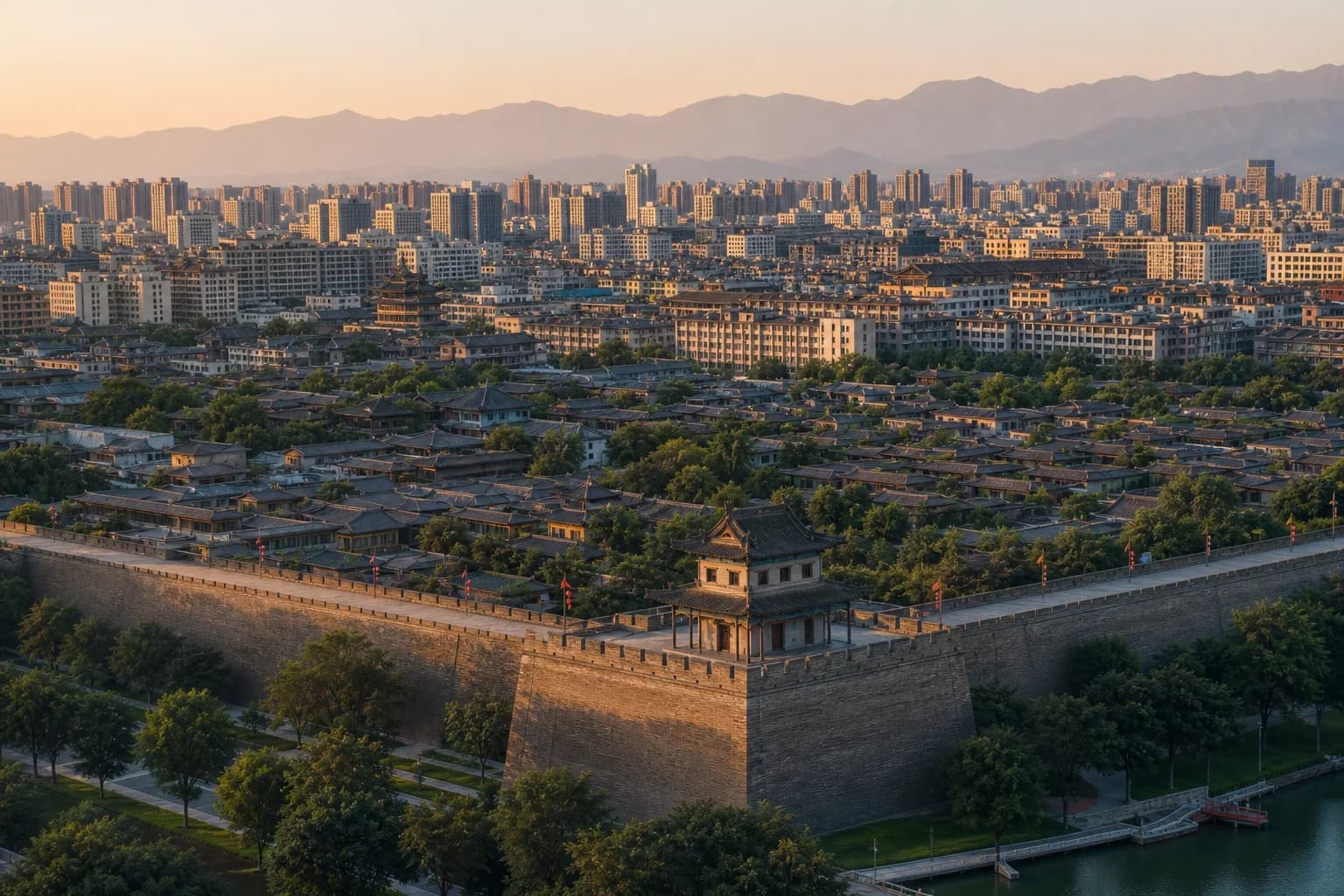
Mount Hua is not one viewpoint reached by one cable car. It is a high granite mountain system in Huayin, east of Xi'an, with two cableways in different valleys, separate mountain shuttle roads, five connected peaks and an old walking ascent from Yuquan Temple. The decision that shapes the day is therefore not “cable car or hiking?” It is where you enter, which peaks you will cross and where you intend to descend.
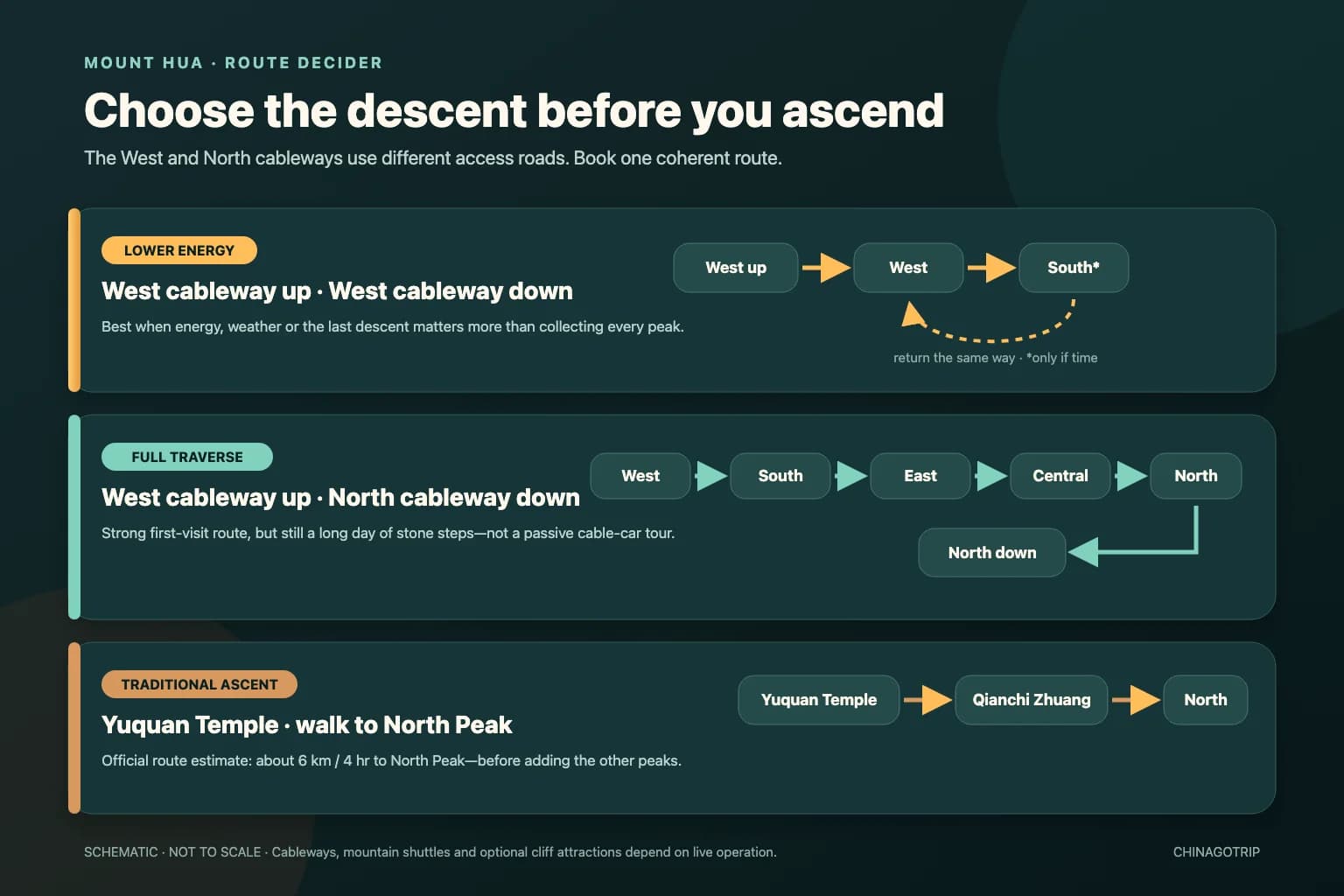
For most first-time international visitors, the best balance is West Peak cableway up and North Peak cableway down. It puts the higher western side first and creates a one-way traverse through West, South, East, Central and North peaks. It still involves hours of stone stairs, exposed-looking railings and congestion at narrow junctions. It is not a low-effort sightseeing ride.
The route graphic is an original schematic built from verified route claims and is not to scale.
Book One Coherent Mountain Product
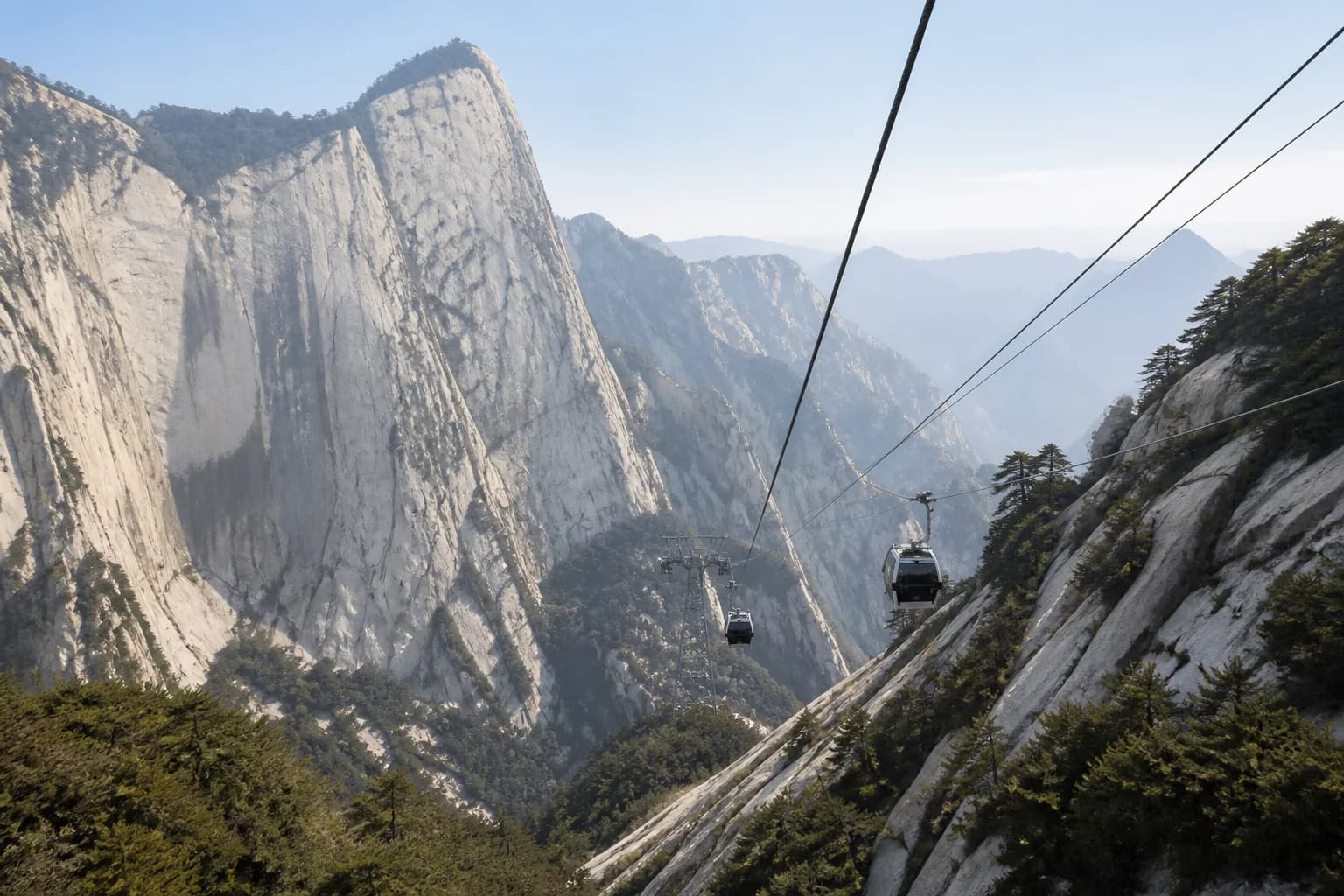
Mount Hua products can combine several things: scenic-area admission, a mountain shuttle to the selected cableway access, and one-way or return cableway rides. These are not interchangeable. West Peak and North Peak cableways have different access buses and lower stations; the visitor centre is the transfer hub, not a trailhead from which both cableways are casually walkable.
Before paying, match every component to one route:
- Confirm the exact visit date and passport or ID requirements.
- Check whether the product includes scenic-area admission.
- Match the outbound mountain shuttle to the cableway you will ride up.
- Match the descent cableway and return shuttle to your planned finish.
- Read the latest last-descent time, maintenance, weather and crowd-control notice.
- Treat the Plank Walk and other controlled cliff activities as optional, separately managed experiences—not normal trail segments.
Check the current Mount Hua listing on Trip.com, but compare the named components rather than the headline price. The official Mount Hua route guide and same-day scenic-area notice control actual access and operation. Never build a train connection around an old screenshot of cableway hours.
Three Routes That Solve Different Problems
1. West Up, West Down: Lower Energy and Easier Contingency
Take the West Peak cableway up, visit West Peak and continue towards South Peak. Add East Peak only if the remaining time, weather and legs support the return. You must retrace the ridge to the West Peak cableway, so every extra peak creates a return cost.
This is the most forgiving cableway plan for families with older children, visitors uncertain about long stair descents, or days when the weather window may close. “Lower energy” is relative: there are still uneven steps, gradients and queues. Its advantage is a simple exit strategy, not a step-free mountain.
2. West Up, North Down: The Full First-Visit Traverse
The one-way sequence is West → South → East → Central → North, followed by the North Peak cableway and its mountain shuttle. The official route guide estimates roughly 1 hour 30 minutes from West through South to East, then roughly 2 hours 40 minutes from East through Central to North. Those are route-planning estimates, not guarantees; photo stops, queues, wet steps and personal pace can make the day much longer.
This route minimizes major backtracking and gives the strongest overview of the five-peak system. It also asks you to keep moving. Skip optional cliff detours when the buffer to the last descent becomes thin. Arriving at North Peak is not the end: allow time for the cableway queue, ride, lower-station shuttle and onward connection.
3. Yuquan Temple to North Peak: The Traditional Walking Ascent
The historic ascent starts at Yuquan Temple, continues through steep stair sections including Qianchi Zhuang, and reaches North Peak. Mount Hua's official guide estimates about 6 kilometres and 4 hours merely to North Peak. Visiting the other peaks comes afterwards. This is therefore a full mountain hike, not a cheaper version of the cableway day.
Strong hikers can continue from North towards Central, East, South and West before descending by cableway, but only with generous daylight, confirmed operation and a realistic pace. A North-cableway-up-and-down circuit is a separate compromise: it reduces the lower climb but leaves more uphill work between North Peak and the higher peaks.
What the Five-Peak Traverse Actually Feels Like
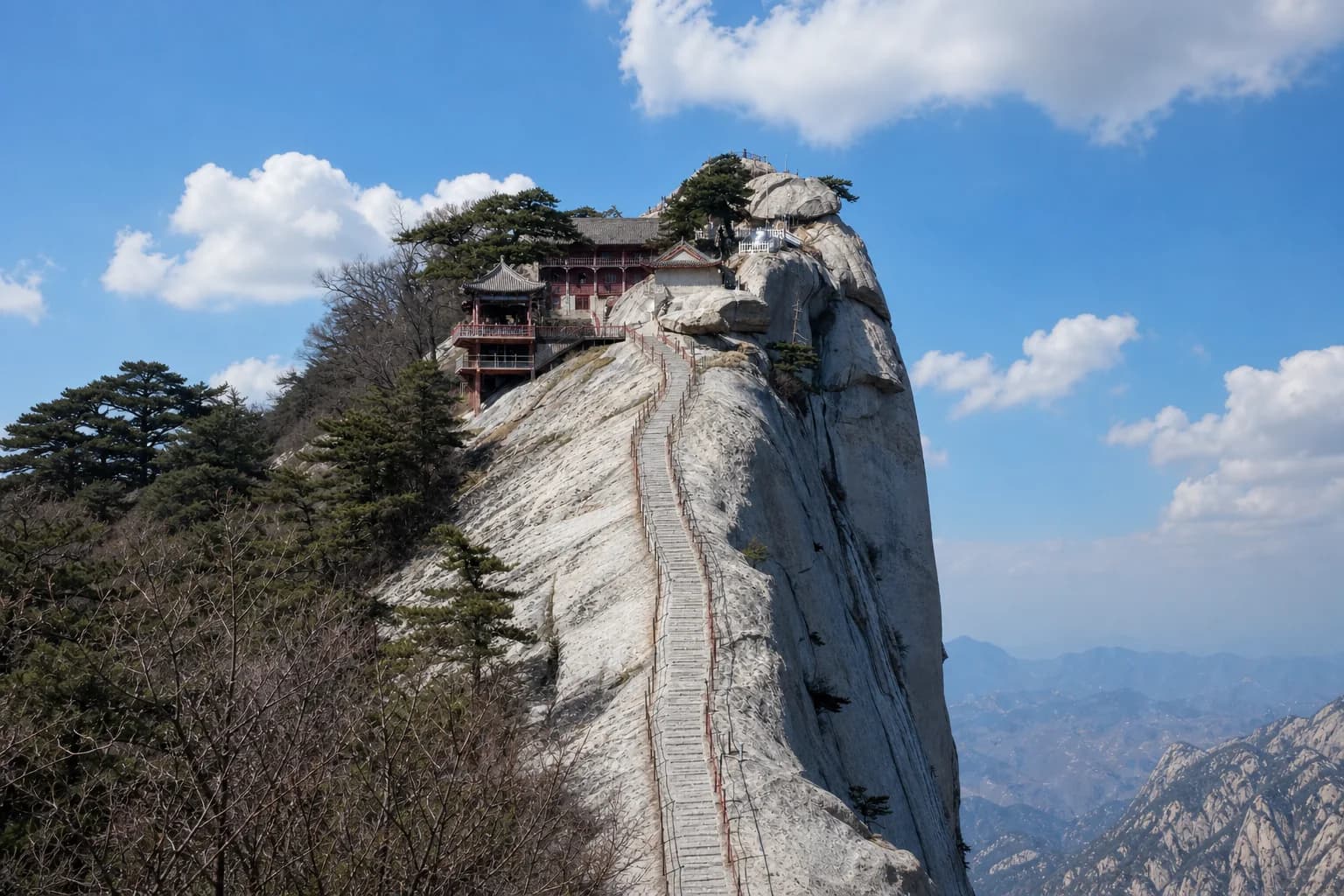
The famous drama comes from pale granite walls, stairways cut across steep slopes, wind-shaped pines and small Taoist buildings placed on improbable-looking ledges. Yet the practical challenge is cumulative: repeated climbs and descents, narrow junctions where two-way traffic slows, and few convenient shortcuts once you commit to the ridge.
- West Peak is the natural beginning for the West cableway routes and a strong first panorama.
- South Peak is the high-point objective on many itineraries, but reaching it still takes stair work after the cableway.
- East Peak is associated with sunrise and contains branches towards controlled cliff activities; those branches are not required for the traverse.
- Central Peak is a connecting peak rather than a grand finale, but it matters for navigation.
- North Peak is lower and functions as the exit for the full traverse or the first major goal of the traditional ascent.
Read every on-mountain sign at the junction where you stand. Mobile maps can place a pin on a peak but do not reliably communicate a closed segment, one-way crowd control or the remaining queue to a cableway.
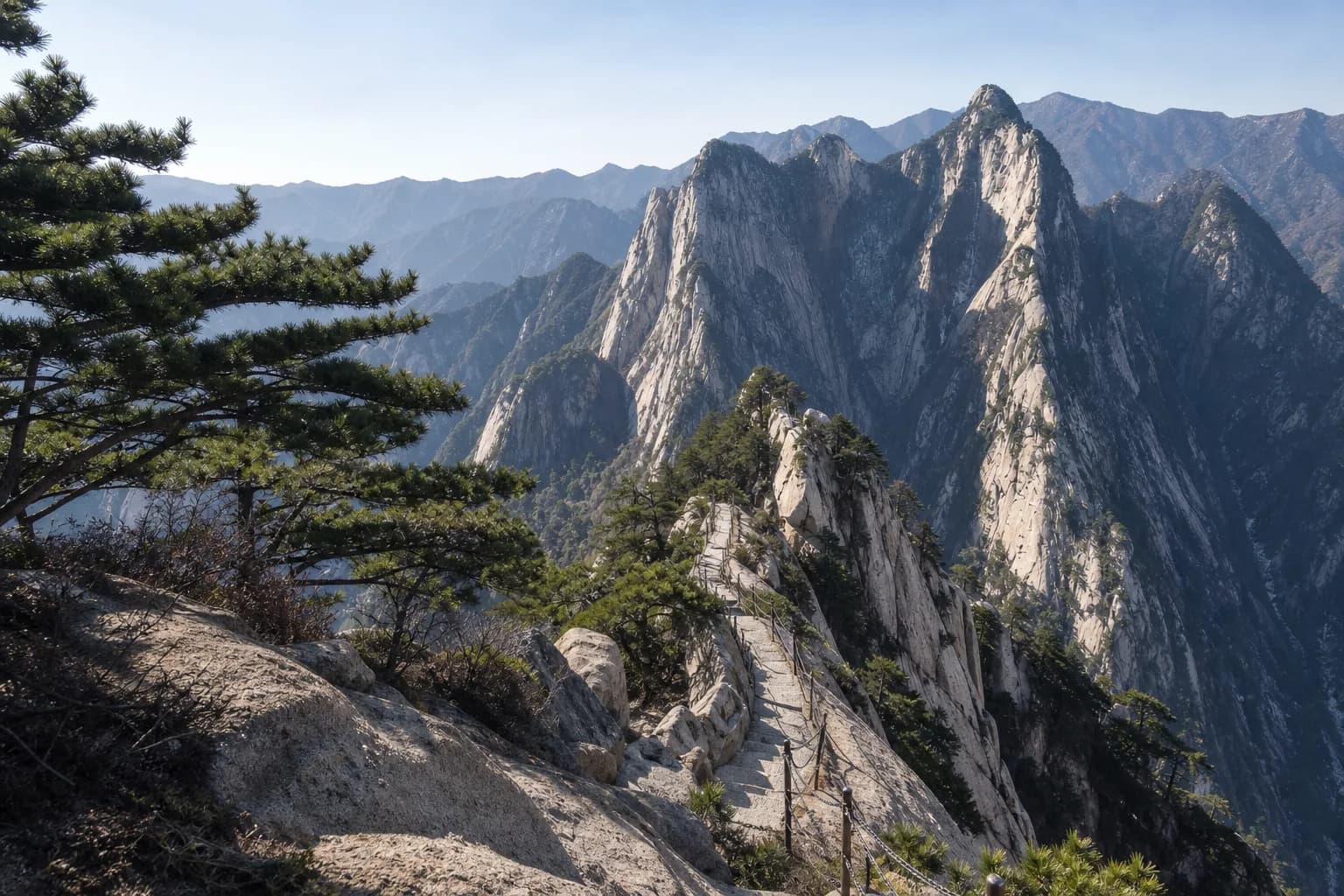
The Plank Walk Is an Optional Detour
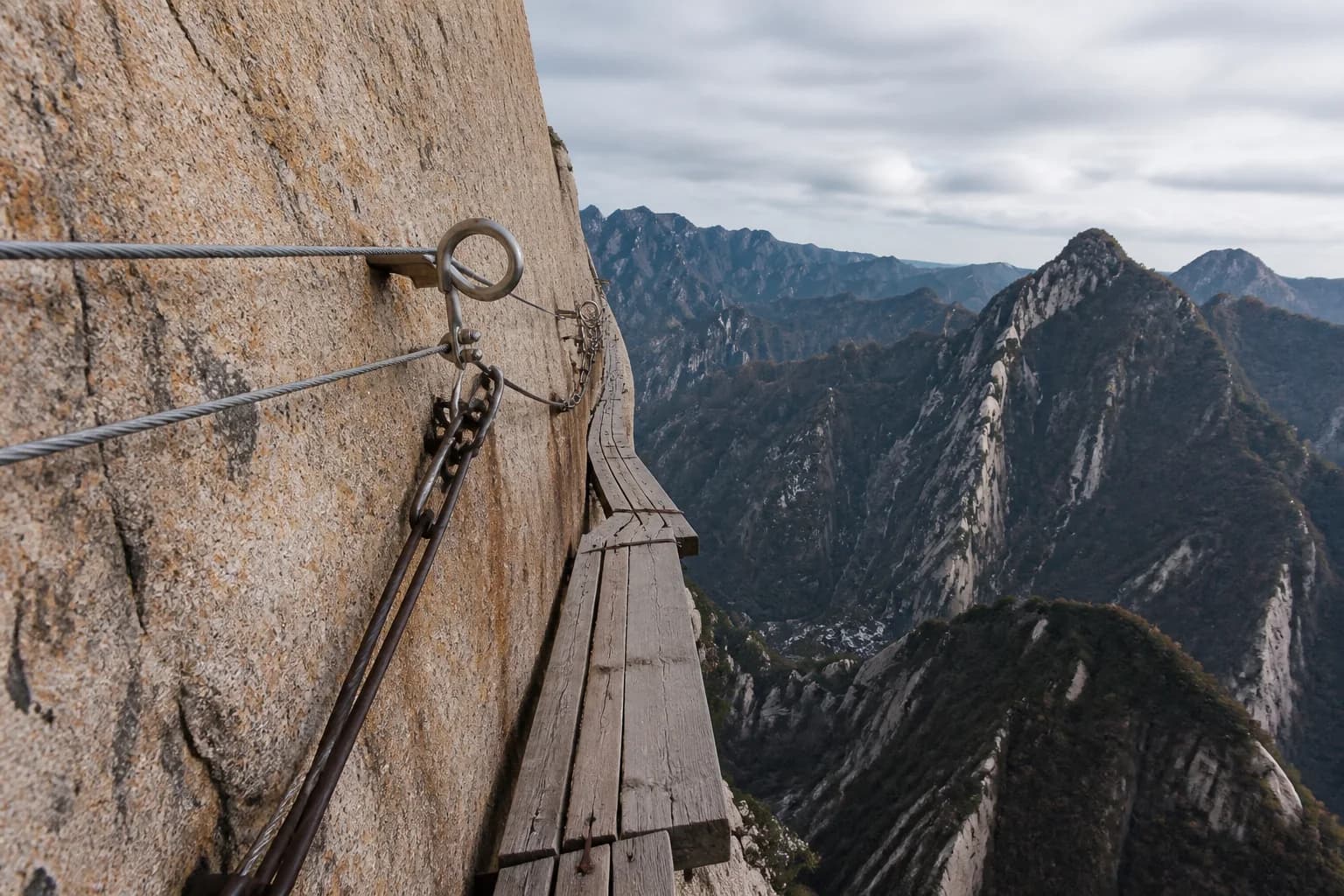
The cliff-side Plank Walk near the South Peak area is a controlled adventure activity with safety equipment, eligibility rules, queues and weather-dependent operation. It is not part of the required path between the main peaks. Visitors who dislike exposure can complete an excellent Mount Hua day without it.
If you want to attempt it, decide only after checking the live operating notice and staff instructions. Allow a separate queue buffer, secure loose items, and accept that wind, rain, ice, maintenance or crowd controls can close access. Do not use an old photo to infer the present boards, harness system, price or operating hours.
Getting to Mount Hua from Xi'an
The cleanest independent trip usually begins with a high-speed train from Xi'an North to Huashan North. Journey times and departures vary, so book the issued train rather than relying on a remembered “half-hour” rule. Compare live China train schedules on Trip.com, leave time for Xi'an North security and passport checks, and avoid the final viable return if your mountain day depends on a cableway queue.
From Huashan North Station, Mount Hua's official guidance mentions local bus routes 1 and 2 or taxis to the visitor centre. In an Amap route-planning check, Huashan North Station to Mount Hua Visitor Center was about 4.8 kilometres and 11 minutes by car; traffic changes that estimate. A mapped public-transport option was materially slower and included walking, so treat any shuttle timetable or “free bus” claim as live operational information, not a permanent promise.
Show the driver or map the exact destination: 华山游客中心. The verified visitor-centre coordinates are 110.098064, 34.538229 (longitude first), and Huashan North Station is 110.098646, 34.581727. Once inside the visitor-centre system, follow the signs for the specific cableway access shuttle named on your ticket.
Food and Water: Eat for the Route, Not the Photograph
Food on the mountain solves fuel and hydration, but choice can be limited and carrying supplies up raises prices. Eat a proper breakfast before the first shuttle. Carry a manageable amount of water, a salty snack and one compact high-energy food; refill or buy more when open vendors make it sensible. Do not burden yourself with the old generic advice to carry a 30–50-litre pack for a cableway day.
After descending, Huayin is a better place for a relaxed hot meal. Look for straightforward Shaanxi staples such as roujiamo, hand-pulled or biangbiang-style noodles, dumplings and warming soups rather than expecting a destination restaurant on the ridge. Near Xi'an, save the elaborate food crawl for a separate evening around the old city: a heavy banquet before Mount Hua is poor preparation for hours of steps.
Where to Stay
Stay in Xi'an for the Normal Day Trip
Choose Xi'an when Mount Hua is one day within a broader city itinerary. A hotel with a simple metro or taxi connection to Xi'an North Station protects the early departure, but it need not be next to the station if your other days centre on the old city or Qujiang. Build the return around a conservative train, not the last bookable one.
Stay in Huayin for an Earlier Start or Weather Buffer
Huayin is more useful when Mount Hua is the trip's main purpose, you want an early cableway position, or you need flexibility to move the mountain day around weather. Compare properties by their actual transfer to Huashan North Station, the visitor centre or Yuquan Temple. A hotel using “Huashan” in its name can still be inconvenient for your chosen entrance.
Stay on the Mountain Only for a Deliberate Sunrise Plan
Summit lodging can support sunrise, but facilities, room types, water, heating, luggage access and seasonal operation may be basic or change. Confirm the exact open property and walking route from your arrival peak. Do not reserve a vague “space capsule” product or begin a night ascent based on an old post.
Compare Xi'an and Huayin hotels on Trip.com by the station or entrance you will actually use, recent access reviews and cancellation terms.
Weather and Safety Rules That Change the Day
Mount Hua deserves ordinary mountain judgement more than thrill-seeking language.
- Wear shoes with reliable grip and use light layers plus rain protection.
- Carry a charged phone and power bank; screenshots help when reception is uneven, but signs and staff override a saved route.
- Keep both hands available on steep stairs. Gloves can improve comfort on cold railings but are not a substitute for careful footing.
- Reduce the route in rain, strong wind, ice, thunder or poor visibility. Cableway operation can change independently of the valley forecast.
- Start a night hike only when it is explicitly permitted, conditions are suitable and you have the equipment and experience for darkness.
- Do not let a prepaid optional activity force an unsafe decision.
A Final Decision Checklist
Before leaving Xi'an, you should be able to answer five questions: Which cableway or trail am I using up? Which route am I walking? Where am I descending? What is the live last-descent constraint? What will I drop first if weather or queues consume the buffer?
For most visitors, the answer is West up, five peaks in order, North down, with the Plank Walk omitted unless the day is running comfortably. For lower energy, return via West. For experienced hikers, begin at Yuquan Temple only after accepting that North Peak is the end of the first major climb—not the end of Mount Hua.