Lou Kau Mansion Macau
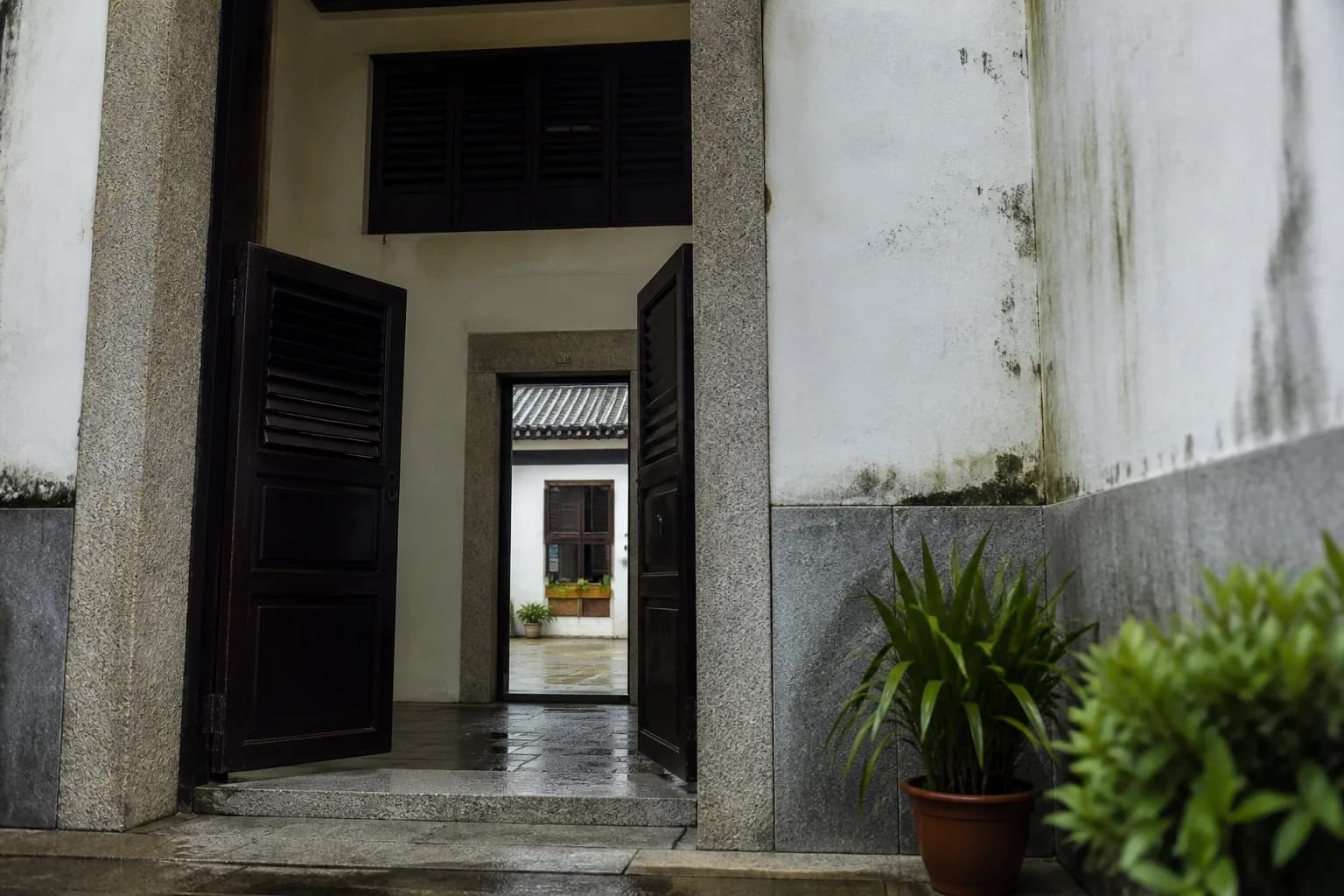
Lou Kau Mansion is not a grand palace. That is precisely why it works. Behind an understated grey-brick facade, a sequence of halls and two narrow courtyards explains how a wealthy Chinese household controlled light, privacy, hierarchy and hospitality in late-19th-century Macau. Chinese planning comes first; Western materials and decorative ideas appear in the details.
The house is compact enough for 35–60 minutes, admission is free, and it sits only a few minutes from Senado Square, the Cathedral and St Dominic's Church. Treat it as the architectural hinge of a Historic Centre walk, not as a two-hour museum visit.
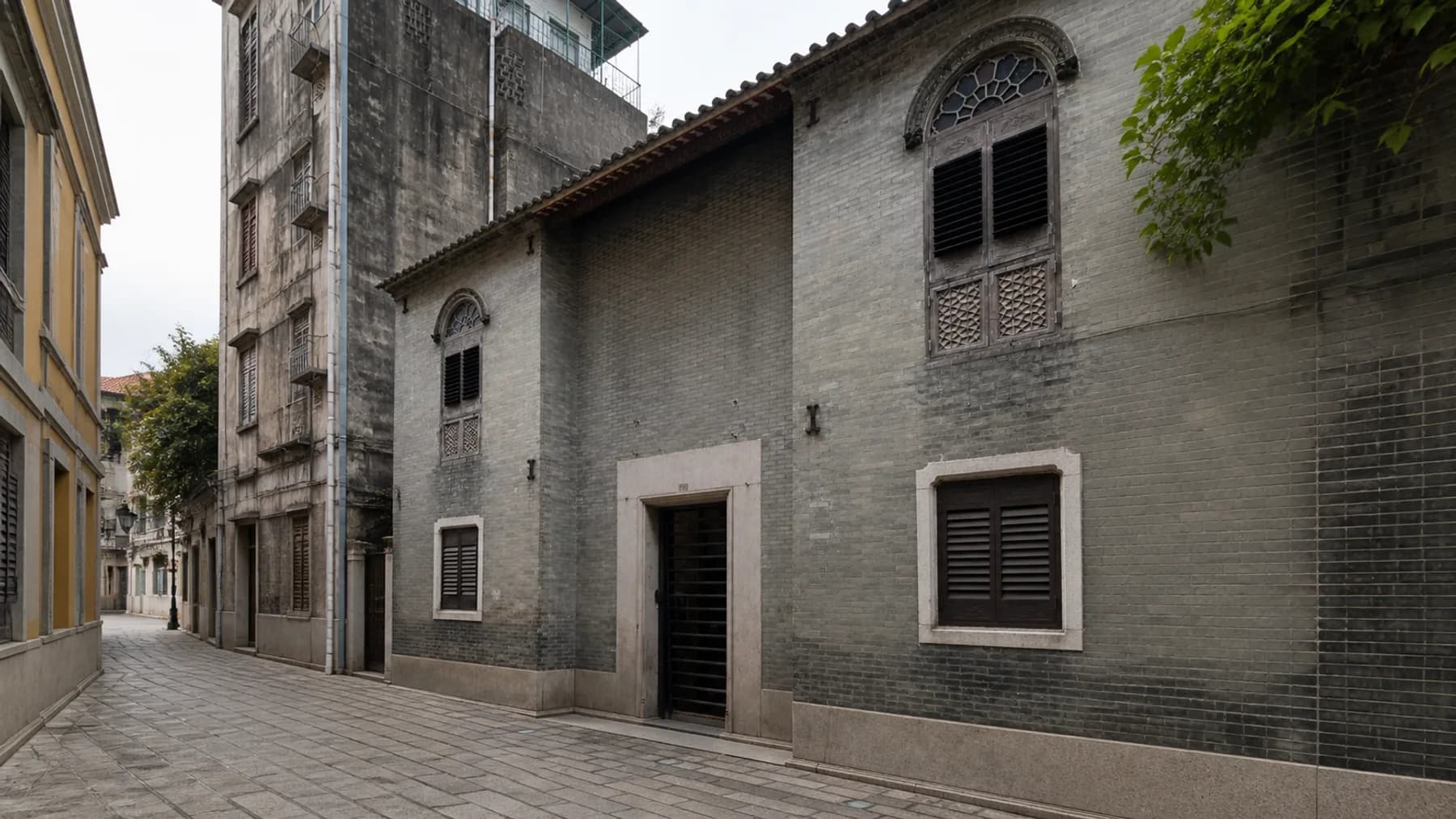
Lou Kau Mansion essentials
| Plan | What to know |
|---|---|
| Address | No. 7 Travessa da Sé, Macau |
| Chinese name | 盧家大屋 / 卢家大屋 |
| Opening hours | 10:00–18:00; last admission 17:30 |
| Weekly closure | Mondays, except public holidays |
| Admission | Free |
| Realistic visit | 35–60 minutes; longer for a tour or special exhibition |
| Upper floor | Normally available only on weekends and public holidays, with a guided visit and capacity control |
| Best pairing | Cathedral, St Dominic's Church and the Ruins of St Paul's |
The Cultural Affairs Bureau can adjust rooms, guided visits or capacity for events and maintenance. Check the official Lou Kau Mansion visitor page shortly before going. The tourism office also publishes a live visitor-flow indicator, useful on weekends and public holidays.
Why this house is more interesting than “Chinese–Western fusion”
Built in 1889 and associated with prominent merchant Lou Kau, the two-storey residence follows a three-bay-wide, three-hall-deep Xiguan house plan. Its central axis runs from the entrance through the Entrance Hall, Sedan Hall and Senior Hall. Two small courtyards bring light and ventilation into a deep urban plot, while the spaces become progressively more private toward the rear.
Look for specific evidence instead of treating every decorative feature as generic fusion:
- Chinese structure: the recessed entrance, feng-shui screen, axial halls, courtyards, grey brick, carved wood, brick reliefs and plasterwork.
- Social choreography: the Sedan Hall marked the point where a guest's conveyance stopped; the deeper Senior Hall received important visitors and carried greater status.
- Macau's material exchange: oyster-shell applications, Manzhou-style colored glass, neo-classical balustrades, cast-iron handrails, Portuguese shutters and perforated wooden ceilings appear inside a fundamentally southern-Chinese house.
Lou Kau Mansion is one component of the UNESCO-listed Historic Centre of Macao, inscribed in 2005. The listing belongs to the wider urban ensemble; it does not mean the mansion is a separate World Heritage property.
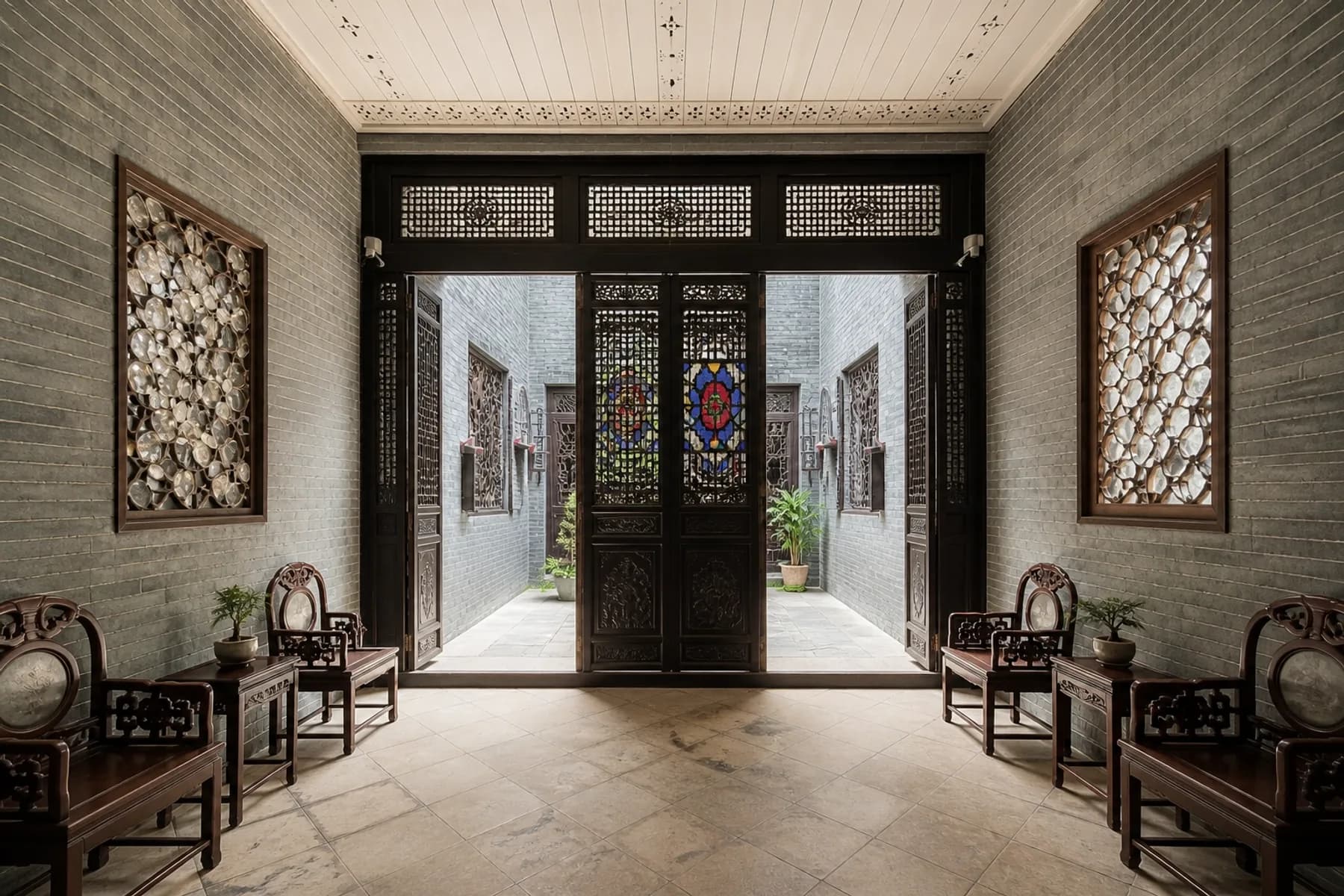
A room-by-room route that makes the house readable
Do not rush to photograph the first courtyard. Walk the central axis once, then return to inspect the sides. This five-step sequence turns a pretty interior into a legible home.
1. Pause outside the recessed doorway
The entrance does not project proudly into the lane. Its deep recess creates shade and transition, while the screen beyond prevents a direct view into family space. Compare this controlled threshold with the open civic space of Senado Square before entering.
2. Read the Entrance Hall as a public boundary
This front hall was the most outward-facing part of the residence. Notice the symmetry and how doors, screens and side bays regulate what a newcomer could see. The building is narrow, but the plan uses layers rather than size to communicate status.
3. Cross the first courtyard into the Sedan Hall
The courtyard is infrastructure as much as decoration: it admits daylight and air into the long plot. The next hall is traditionally identified as the Sedan Hall, where sedan chairs stopped. Stand on the central axis and look backward; the compressed sequence of frames is one of the house's best views.
4. Slow down at the second courtyard
This is the best place to compare materials. Search for carved timber, plaster decoration, grey brick, colored glass and shell-like translucent panels. Do not touch historic surfaces or block the narrow circulation route while photographing.
5. Finish in the Senior Hall, then check upper-floor access
The high-ceilinged Senior Hall sits deeper in the house and was used for important guests. Its position makes the household hierarchy tangible: ceremonial and private value increase with distance from the street. The upper floor is not a guaranteed add-on. Official visitor information says it normally opens on weekends and public holidays through guided visits, with a maximum of ten participants.
Public guided visits are generally offered in Mandarin or Cantonese on weekends and public holidays, hourly from 10:00–13:00 and 14:00–17:00, with on-site registration and limited places. Confirm the day's arrangement when you arrive rather than building an inflexible itinerary around it.
The best half-day heritage route
The mansion is strongest when it connects Macau's Chinese merchant history with the surrounding Christian and civic city. AMap verifies that all the key legs are short, although the pedestrian lanes are busy and the diagram below is schematic.
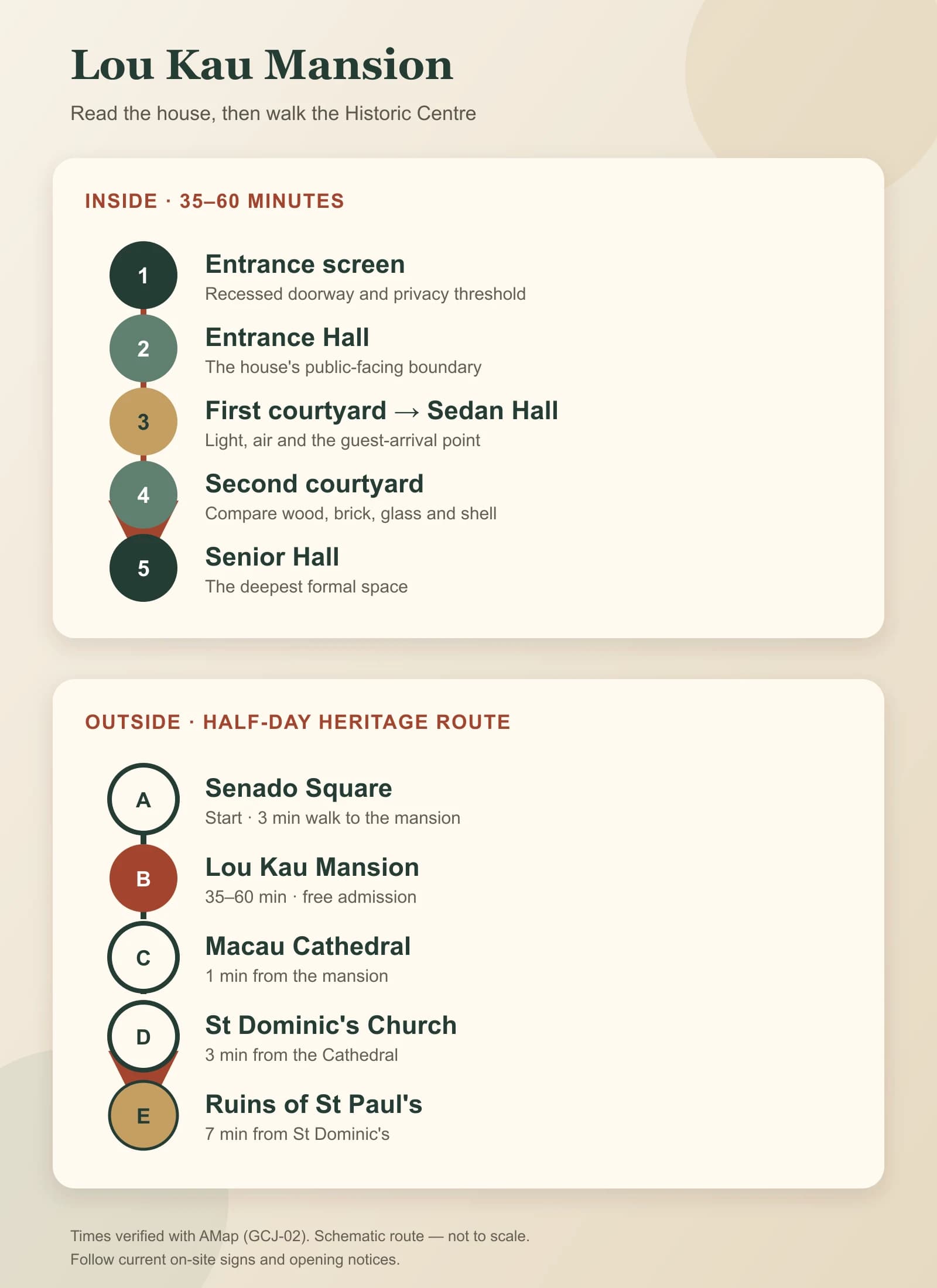
Recommended sequence: 2.5–3.5 hours
- Senado Square — 20–30 minutes. Read the civic setting and wave-pattern paving before the lanes become crowded.
- Lou Kau Mansion — 35–60 minutes. The verified walk from Senado Square is about 166 m, or 3 minutes.
- Macau Cathedral — 15–25 minutes. It is roughly 69 m, or 1 minute, from the mansion. This immediate contrast between a Chinese merchant residence and the Catholic centre is the route's most distinctive idea.
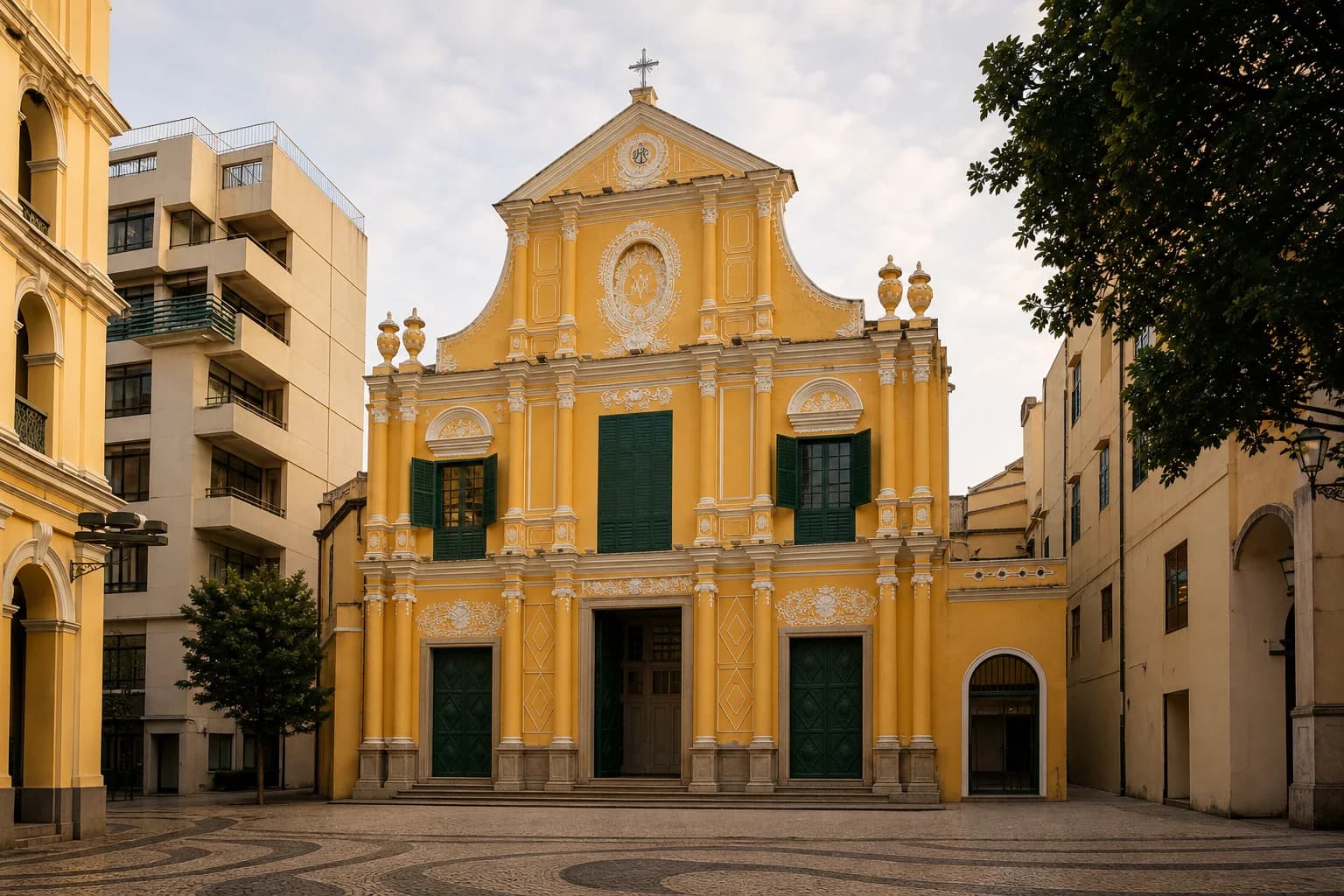
- St Dominic's Church — 20–30 minutes. From the Cathedral, the verified walk is approximately 194 m, or 3 minutes. Check current interior access before relying on more than a facade stop.
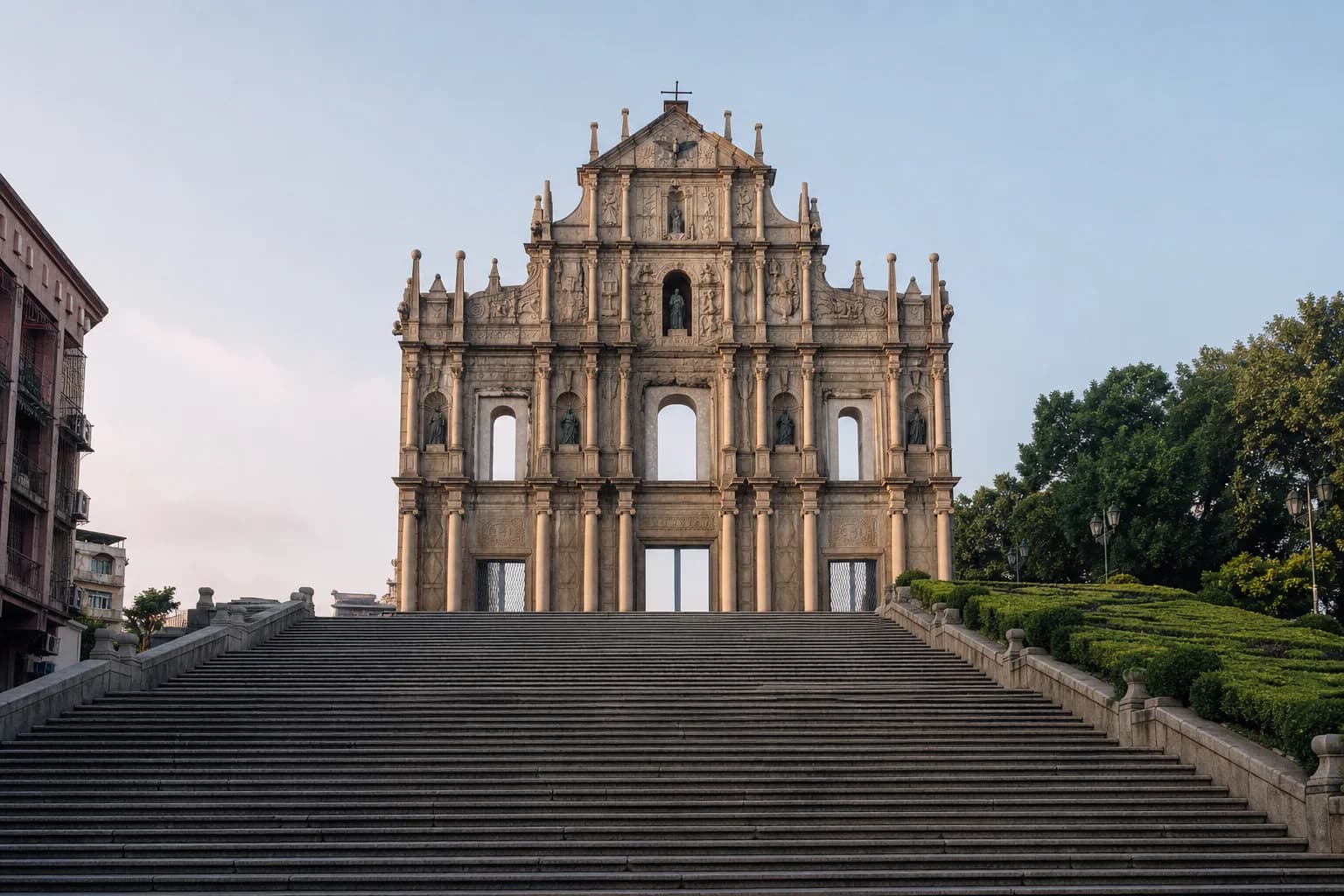
- Ruins of St Paul's — 30–45 minutes. Allow about 7 minutes for the roughly 459 m walk from St Dominic's, then extra time for the steps and museum area.
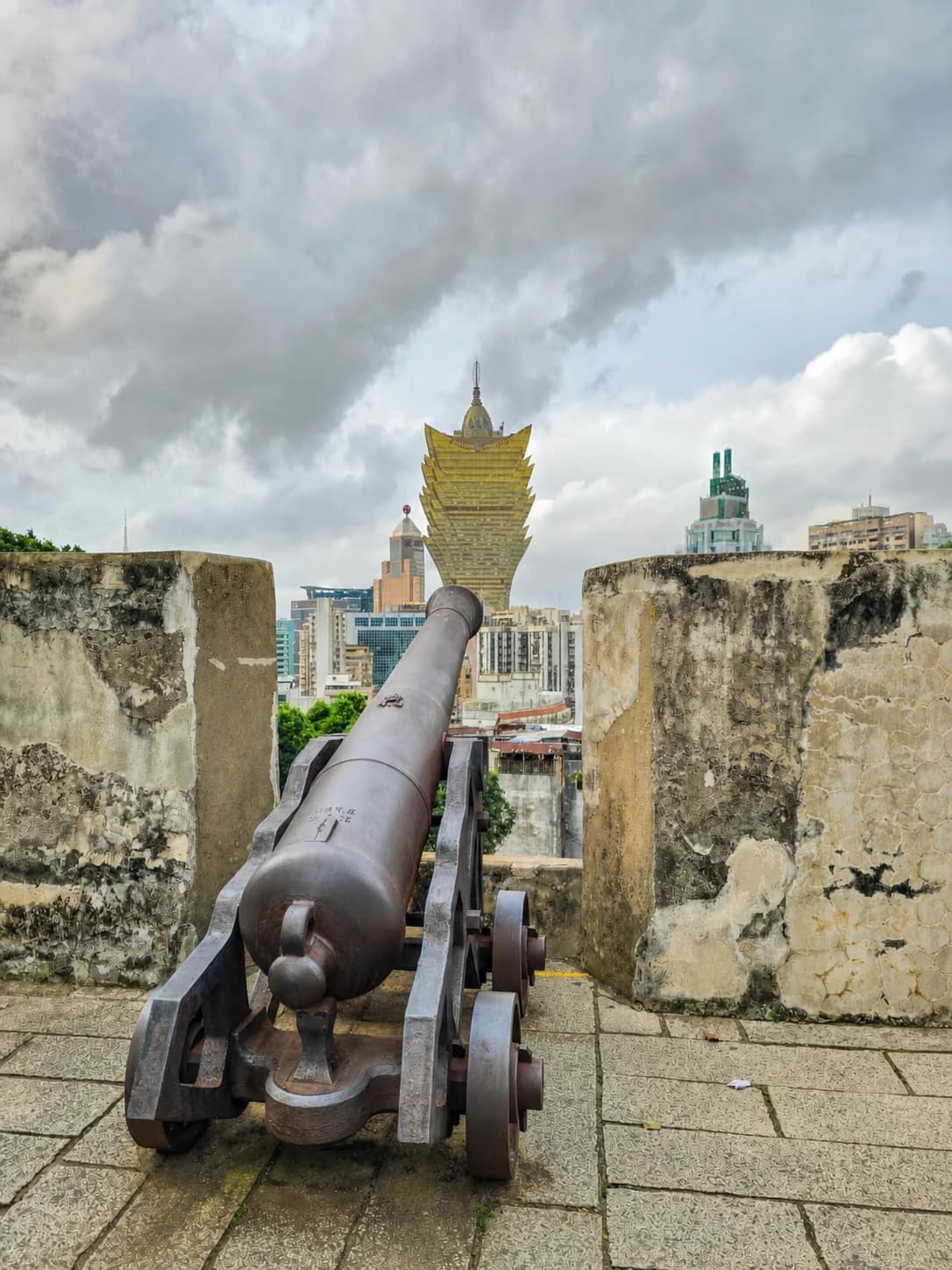
This is a heritage walk, not a literal loop: it finishes near St Paul's. Continue to Mount Fortress, eat nearby, or follow our full Macau heritage itinerary if you want the wider multi-day sequence.
For a quieter version, visit Lou Kau Mansion near opening, then the Cathedral and St Dominic's before ending at Senado Square for lunch. On a hot or rainy day, keep the mansion as the indoor anchor and cut St Paul's rather than sprinting through every stop.
What to eat nearby: choose a food pattern, not a viral shop
The lanes around Senado Square and St Paul's are dense with snack counters, bakeries and souvenir stores. Individual shops change, queues spike and social-media favorites can become poor uses of limited time. Choose the dish first, then buy from a clean, busy counter with fresh turnover.
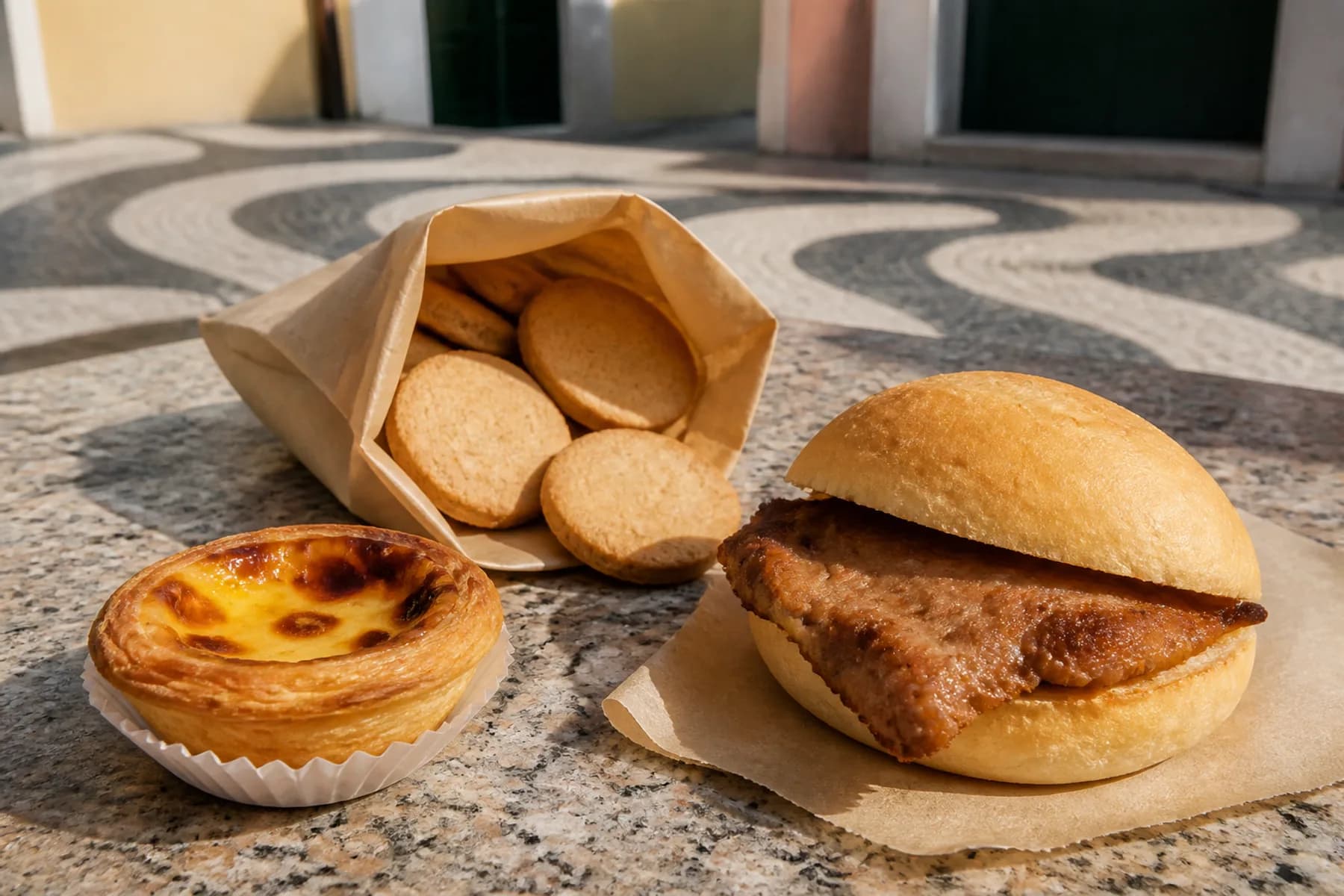
- Portuguese egg tart: best as a warm mid-route snack. A blistered custard top and crisp laminated shell matter more than the most photographed storefront.
- Almond cookies: useful as a take-home taste rather than a full meal. Sample before buying a large box; textures range from sandy and crumbly to firm.
- Pork-chop bun: a practical savory lunch if you want to keep walking. Check whether the chop is cooked to order and expect bones in traditional versions.
- Macanese sit-down meal: save more time for minchi, African chicken or baked Portuguese-style rice. These dishes make more sense after the route than squeezed between two churches.
For less crowd friction, step one or two lanes away from the direct Senado–St Paul's stream. Keep your route flexible: eat when a suitable counter has a manageable queue rather than crossing the district for a single recommendation.
Where to stay for this route
Choose a district from your overall Macau plan before comparing hotels.
- Historic Centre / Inner Harbour: best for early walks to Senado Square, Lou Kau Mansion and St Paul's. Older blocks can have small rooms, limited vehicle access and uneven or sloped approaches, so inspect the actual entrance route.
- NAPE / central waterfront: a useful compromise for modern hotels and peninsula sightseeing. You will usually need a bus or taxi for part of the day, but returning from the old centre is straightforward.
- Taipa or Cotai: best for resort facilities, shows and large hotel complexes—not for stepping out into the Historic Centre. Budget cross-city transport time and avoid pretending the mansion is “nearby” because Macau looks compact on a map.
Compare Macau hotels on Trip.com after choosing the district. Check the property's current shuttle, smoking policy, breakfast terms and the walking route from the exact lobby before booking.
Practical details people discover too late
- Capacity is limited. Official guidance lists a maximum of 30 visitors per session; waits are possible even though the building is small.
- The upper floor is conditional. Plan a satisfying ground-floor visit first. Weekend or public-holiday access is guided and capped.
- Last entry is 17:30. Arriving then leaves little room to understand the house. Aim for at least 45 minutes before closing.
- Photography has limits. Ordinary commemorative photography is generally allowed, but commercial, wedding or modelling shoots require advance approval. Avoid flash, tripods and obstructing circulation unless staff explicitly permit them.
- Accessibility is partial. The historic threshold, narrow passages and upper-floor stairs can be difficult. Ask staff what is open step-free on the day.
- Weather still matters. The house provides shade, but courtyards and the connecting heritage walk are exposed to humidity and heavy rain. Carry water and a compact umbrella.
Is Lou Kau Mansion worth it?
Yes, if you already plan to be in the Historic Centre and enjoy architecture, domestic history or short, high-detail visits. It offers more insight per minute than many grander photo stops because the layout remains easy to read.
Skip it only if you have no interest in interiors or your schedule allows less than 20 minutes before closing. For a larger and more expansive residential comparison, pair it on another day with Mandarin's House. Lou Kau Mansion is the compact merchant-house lesson; Mandarin's House is the longer residential complex.