A-Ma Temple Macau
A-Ma Temple (妈阁庙; Templo de A-Má) is not one symmetrical building. It is a sequence of stone gates, small halls, granite outcrops and shaded stairs rising above Barra Square. That irregular hillside arrangement is the point: maritime worship, Buddhist devotion and Chinese folk belief accumulated here over centuries rather than arriving as one finished monument.
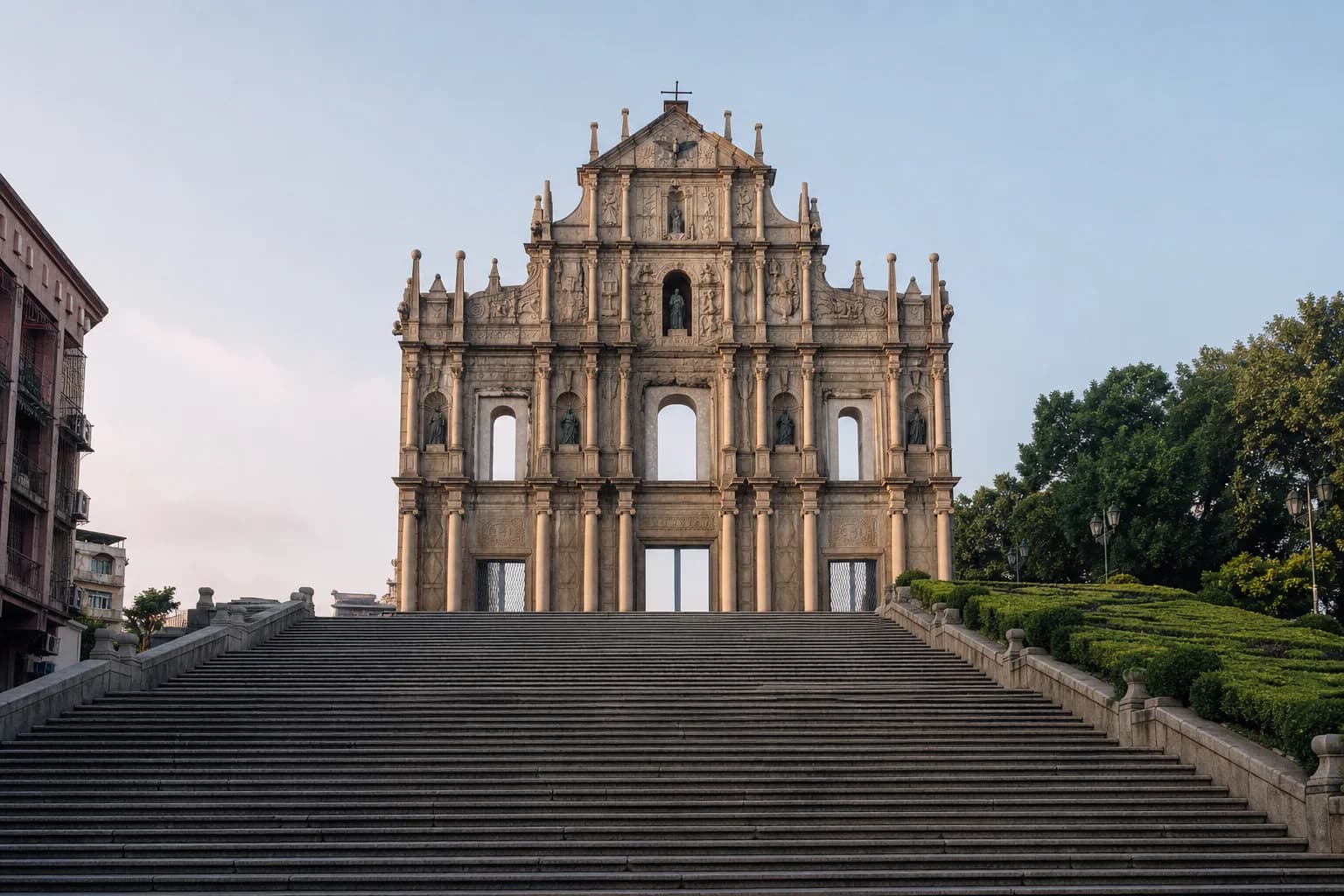
The temple is also the southern anchor of the Historic Centre of Macao, the UNESCO-listed urban landscape that continues north through Mandarin's House, churches, civic squares and the Ruins of St. Paul's. Visit the halls first, then walk into that city rather than treating the temple as an isolated photo stop.
Quick visitor facts
- Current official hours: 8:00 am–6:00 pm, according to the Macao Government Tourism Office. Check the same official page before a festival or public-holiday visit.
- Admission: free under normal operations.
- Useful visit length: 45–60 minutes for the complex; allow 75 minutes if you read inscriptions, pause for worship or move slowly on stairs.
- Best first visit: weekday morning, when the light reaches the gate and the halls are easier to enter without interrupting worshippers.
- Terrain: short but uneven stone steps, slopes and narrow landings. Heat and humidity make the climb feel longer than the map suggests.
- Nearest rail: Macau Light Rapid Transit's Barra station. AMap measures the walk to the temple at about 0.5 km / 7 minutes; allow longer for crossings and orientation.
- Best onward route: Moorish Barracks exterior → Lilau Square → Mandarin's House.
- Festival warning: Lunar New Year and A-Ma's birthday bring meaningful living culture, but also incense, crowd controls and temporary route changes.
A practical route through the temple
The official visitor description lists the Gate Pavilion, Memorial Arch, Prayer Hall, Hall of Benevolence, Hall of Guanyin and Zhengjiao Chanlin, a Buddhist pavilion. Names vary slightly between translations and signs. Do not turn the visit into a hall-counting exercise; follow the terrain and notice how the religious focus changes as you climb.
1. Begin outside the gate
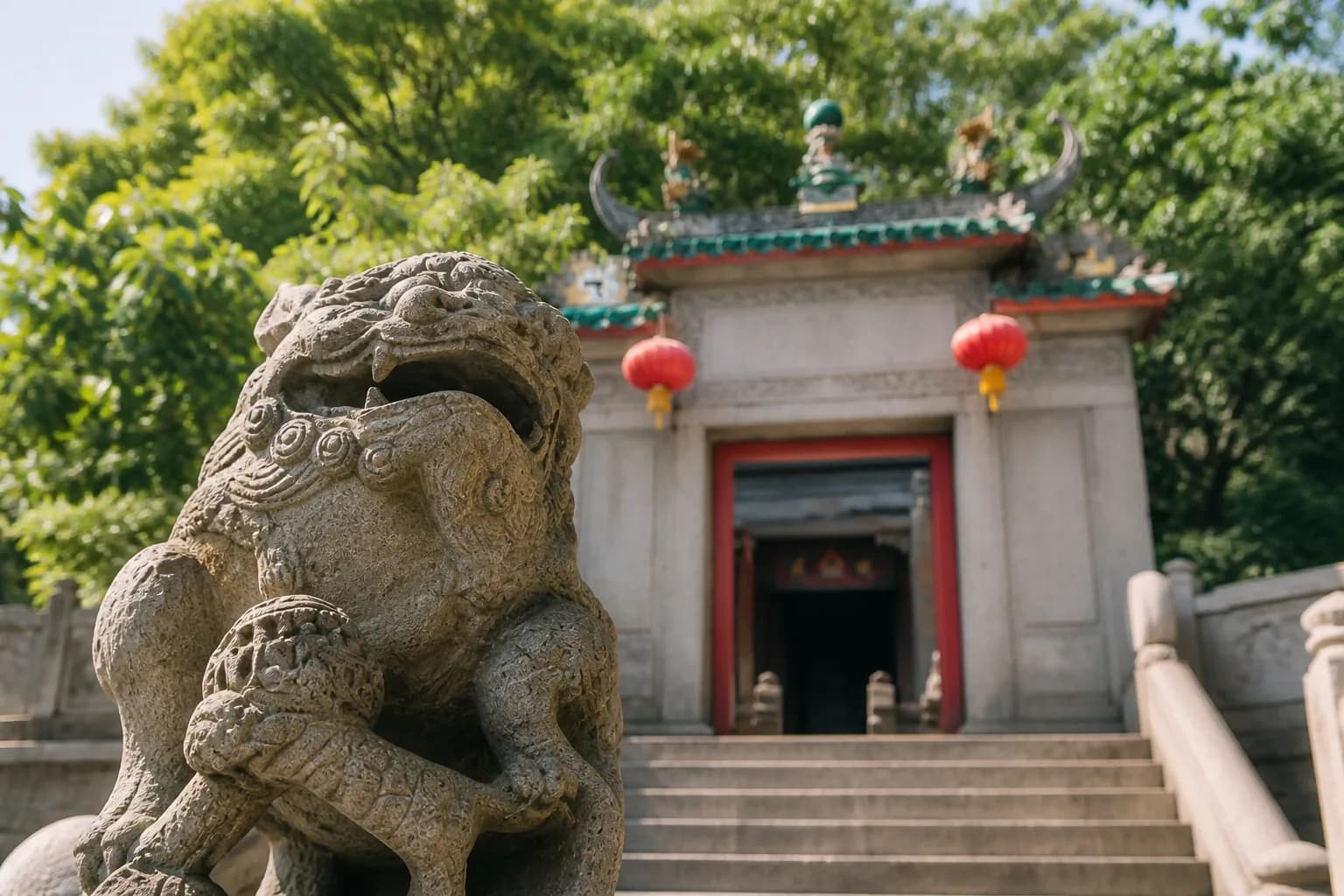
Cross Barra Square and step back before entering. The gate's grey granite, green-glazed roof edges, sculpted ridge figures and guardian lions form a compact threshold against the wooded slope. Photograph the whole relationship first. A close phone shot of one lion loses the reason this entrance is distinctive.
The paving and open square also reveal how dramatically reclamation changed Macau. The temple once addressed the Inner Harbour more directly. UNESCO still describes the visual connection between A-Ma Temple and the river as part of the historic centre's integrity, even though today's shoreline and roads are different.
2. Pass the arch and find the oldest spatial layer
Inside, the path narrows around rock rather than opening into one grand courtyard. Pause after the arch, let people finish offerings, then approach the lower halls. The Hall of Benevolence is commonly associated with the complex's earliest surviving fabric, while other buildings were added or rebuilt in later Ming and Qing periods.
The familiar claim that “the temple was built in 1488” is too neat. Scholarship published by Macau's Cultural Affairs Bureau distinguishes between founding legends, an early shrine and later formal temple construction. Treat 1488 as a traditional date associated with an early A-Ma shrine—not proof that every pavilion you see dates from one year.
3. Read the Prayer Hall as a maritime space
A-Ma, also known as Mazu or Tin Hau, protects seafarers in the coastal traditions that spread from Fujian. The hall's scale is intimate because worship is personal: offerings, incense and requests for safe journeys matter more than monumental spectacle.
If a worshipper is in front of the altar, wait at the side. Do not place a phone between a person and the deity, and do not imitate a ritual merely for a photograph. Temple staff may restrict incense or paper offerings for fire safety; follow the instructions present that day rather than an online formula about an exact number of sticks.
4. Climb toward Guanyin and Zhengjiao Chanlin
Continue only where the signed route is open. The upper sequence uses stairs and rocky terraces, revealing how pavilions are fitted into Barra Hill. The presence of A-Ma, Guanyin and Buddhist spaces in one compound is not a contradiction. The tourism office presents the complex as an example of Chinese culture shaped by Confucian, Taoist, Buddhist and multiple folk-belief traditions.
At each landing, look backward. Roof ridges, tree canopy, granite and glimpses of the city layer together more clearly from above than at the entrance. After rain, polished stone can be slippery; the uppermost viewpoint is never worth pushing past a barrier.
5. Descend without crossing the worship flow
Use the indicated circulation path and give ascending visitors room on narrow steps. Before leaving, return to the lower courtyard for one quiet overview. The visit should feel like an unfolding series of thresholds, not a race to the highest point.
What the architecture rewards you for noticing
The temple's most memorable feature is its asymmetry. Conventional axial planning gives way to buildings distributed across rock and vegetation. That loose arrangement allows each hall to feel separate while the gate, walls and paths hold the complex together.
Look for four material details:
- Granite fitted to terrain. Steps, balustrades and walls meet natural rock rather than erasing it.
- Upturned roof ridges and charms. Small ceramic figures make more sense against the sky than in an extreme zoom.
- Lattice windows and gable forms. Official tourism material highlights the craftsmanship of latticework, flush gable roofs and decorative porcelain pieces.
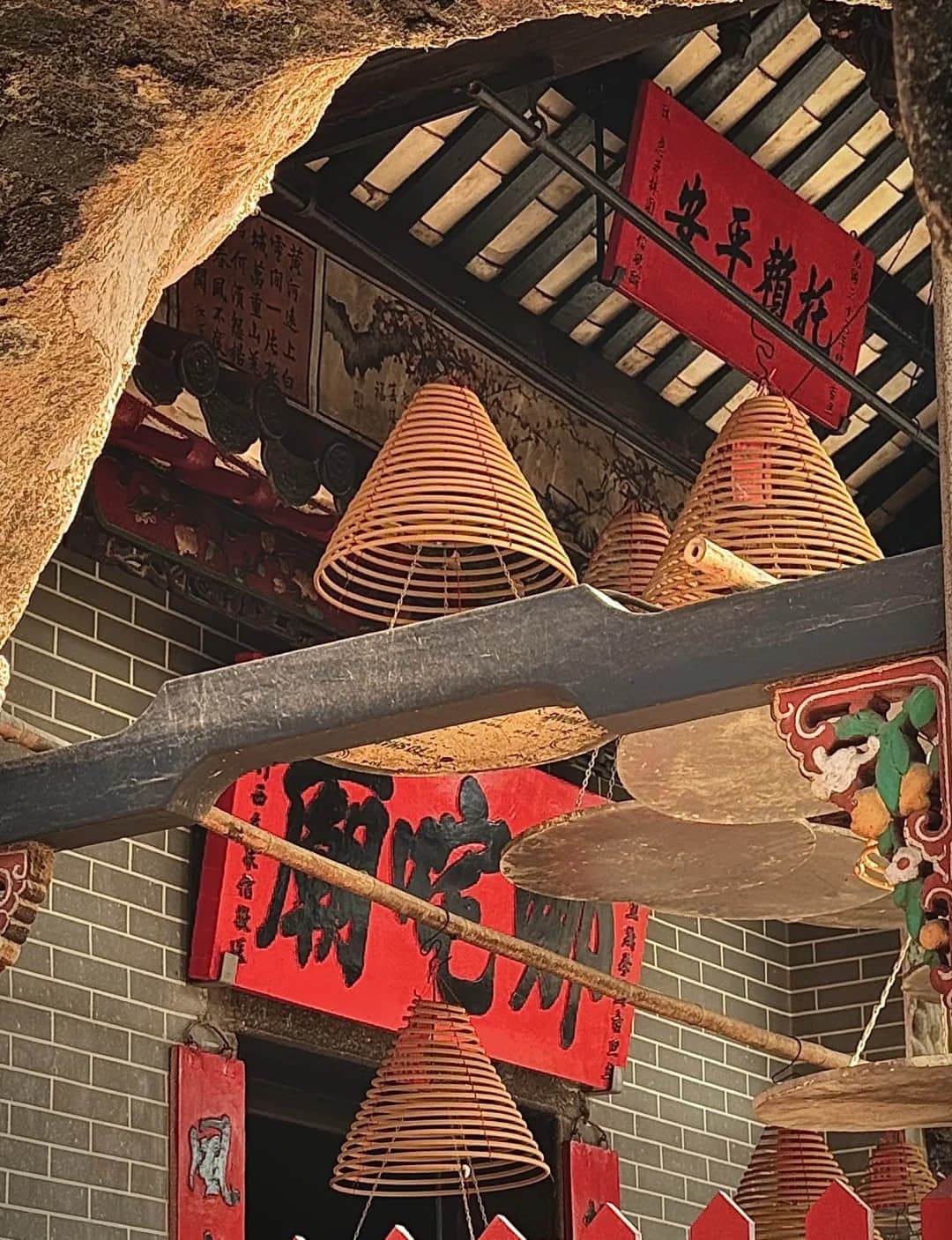
- Calligraphy and inscriptions. They record layers of patronage and interpretation. Photograph them as historical surfaces; do not invent a translation from a partial character.
This material vocabulary makes A-Ma Temple a useful contrast with nearby Mandarin's House. One adapts sacred pavilions to a rocky slope; the other organizes domestic life through courtyards, service spaces and long residential wings.
The name “Macau”: a story with a caution label
The popular story says Portuguese sailors asked the name of the place near the temple, heard something like A-Ma-Gau or “Bay of A-Ma,” and transformed it into Macau. Macau cultural sources do connect the Portuguese name with A-Ma traditions, but historical research debates the exact linguistic route and the date or form of the early shrine.
The responsible takeaway is broader and more interesting: A-Ma worship was embedded in the port community, the temple became a landmark for arrivals, and maritime belief helped shape how Macau explained itself. Present the name story as a strong cultural association, not a transcript of one proven conversation on the shore.
Living worship, wishes and photography
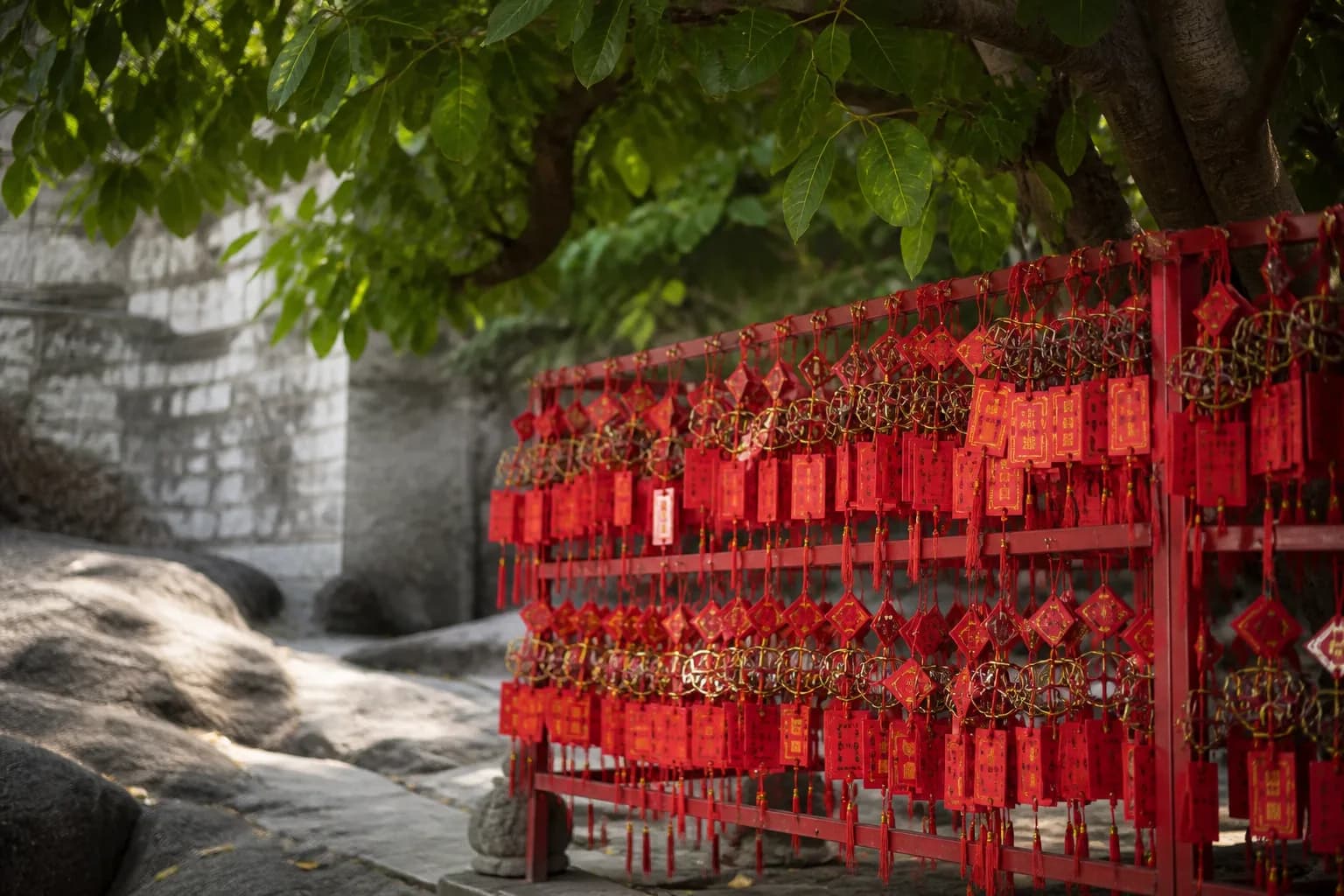
A-Ma Temple is active religious space, not a preserved stage set. Visitors may encounter incense, prayer tags, offerings or a ceremony, but availability and placement can change.
Use a few simple rules:
- Keep voices low and calls outside the halls.
- Do not photograph faces, written wishes or divination results without permission.
- Never photograph directly across someone who is bowing or presenting an offering.
- Avoid flash, tripods and repeated staged takes in narrow worship areas.
- Step over a threshold rather than standing on it when local signs or custom request this.
- Buy incense or a prayer item only if you understand how staff want it used. There is no universal tourist ritual or guaranteed fortune outcome.
A-Ma Festival: choose participation over spectacle
A-Ma's birthday falls on the 23rd day of the third lunar month. The official 2026 programme ran in May and included Cantonese opera in Barra Square. The date changes in the Gregorian calendar, and future schedules should be checked on the tourism office's current events page.
This is one of the site's most distinctive cultural layers: beliefs and customs surrounding A-Ma are recognized as Macau intangible cultural heritage. During celebrations, arrive with extra time, obey crowd controls and let devotees reach the halls first. Cantonese opera, offerings and community organization are not decorative entertainment assembled for tourists.
Continue on the south Macau heritage walk
Do not jump directly from A-Ma Temple to the Ruins of St. Paul's. The southern historic centre has a coherent short route of its own.
A-Ma Temple → Moorish Barracks
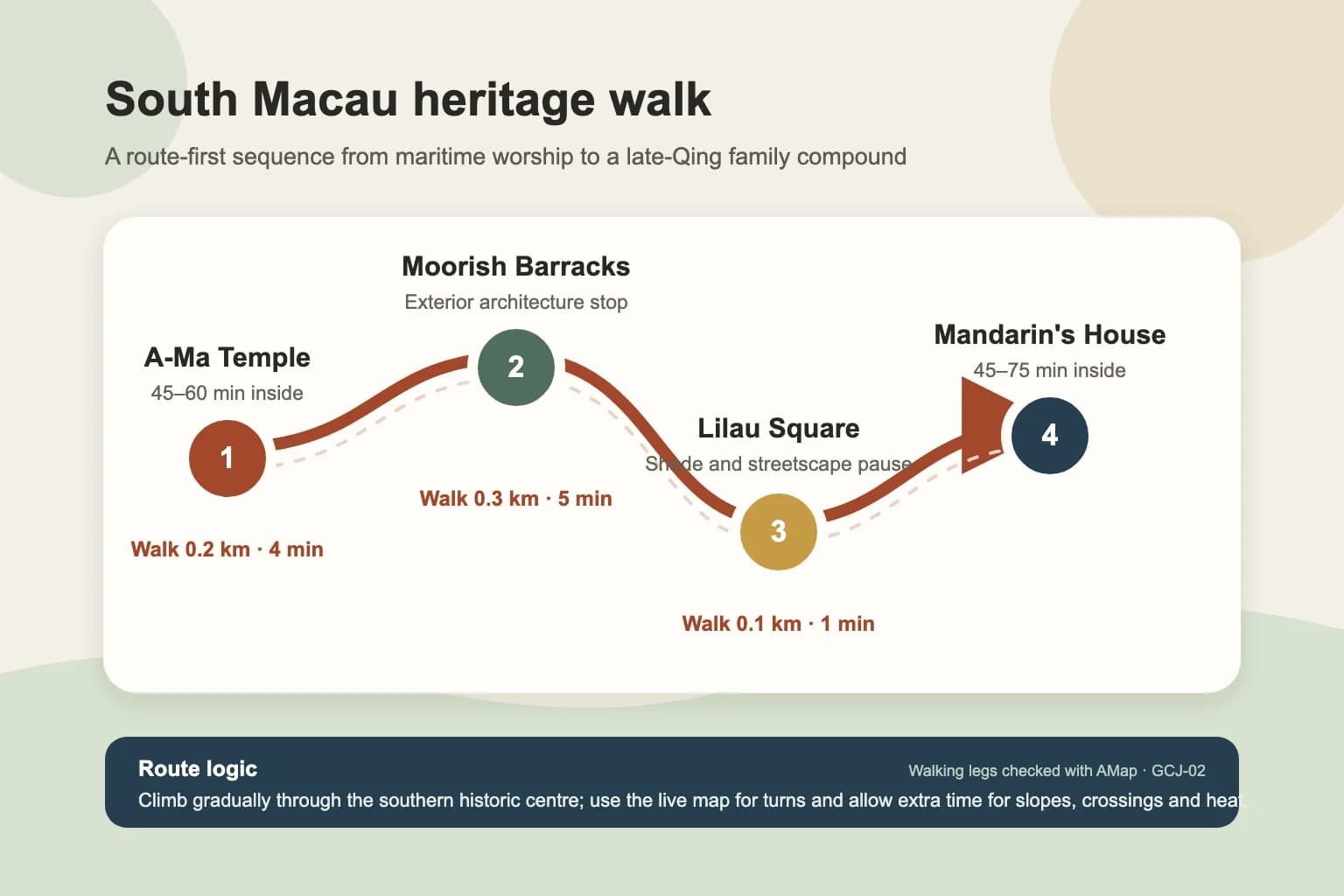
AMap measures this uphill leg at about 0.2 km / 4 minutes. The pale arcades and rhythmic veranda of the 1870s barracks are best read from the street; it remains an institutional building, so do not assume interior access.
Moorish Barracks → Lilau Square
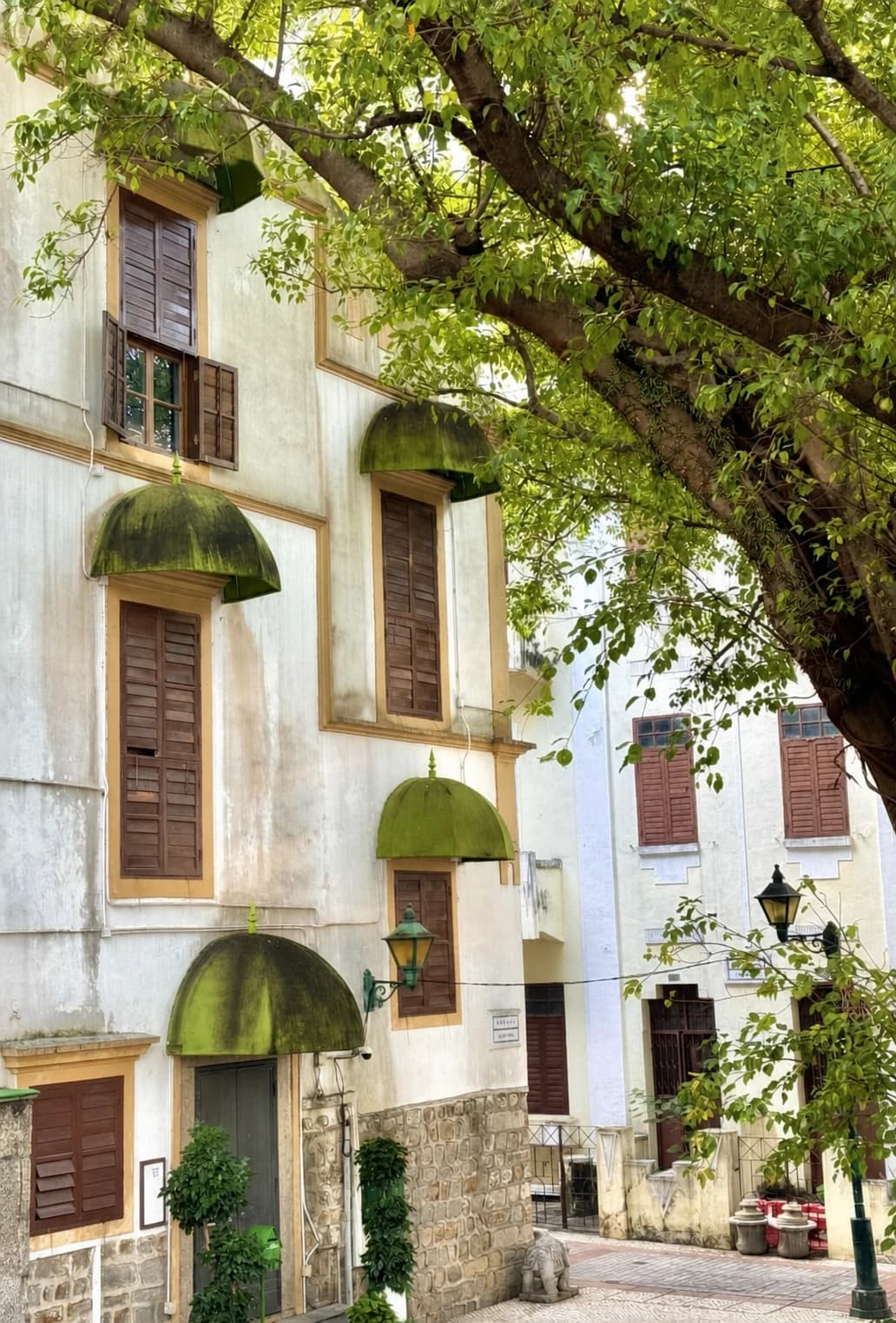
Continue about 0.3 km / 5 minutes through the sloping lanes. Lilau is a shaded pause rather than a checklist attraction. Notice Portuguese-style paving, low residential scale and the change from port infrastructure to neighborhood space.
Lilau Square → Mandarin's House
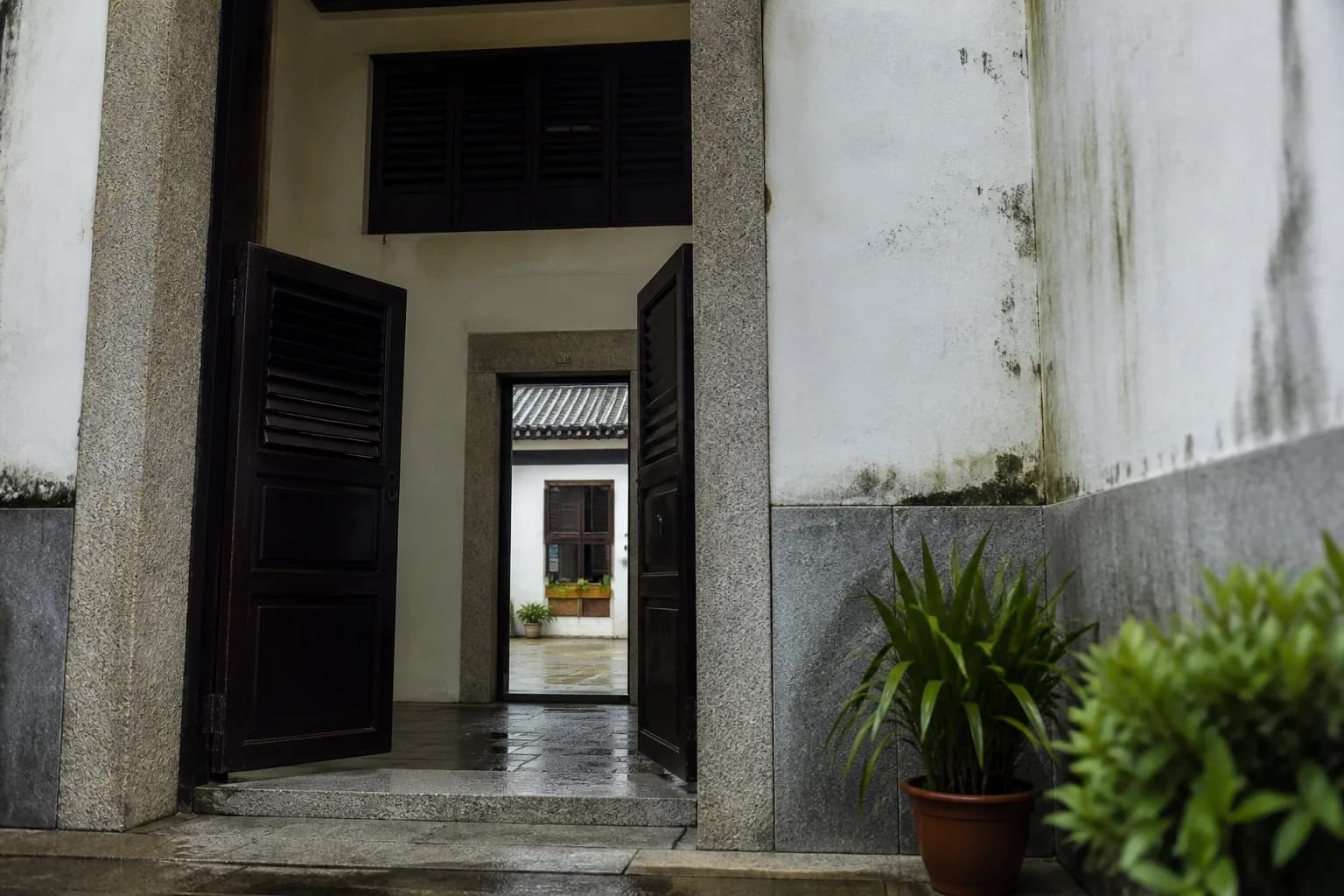
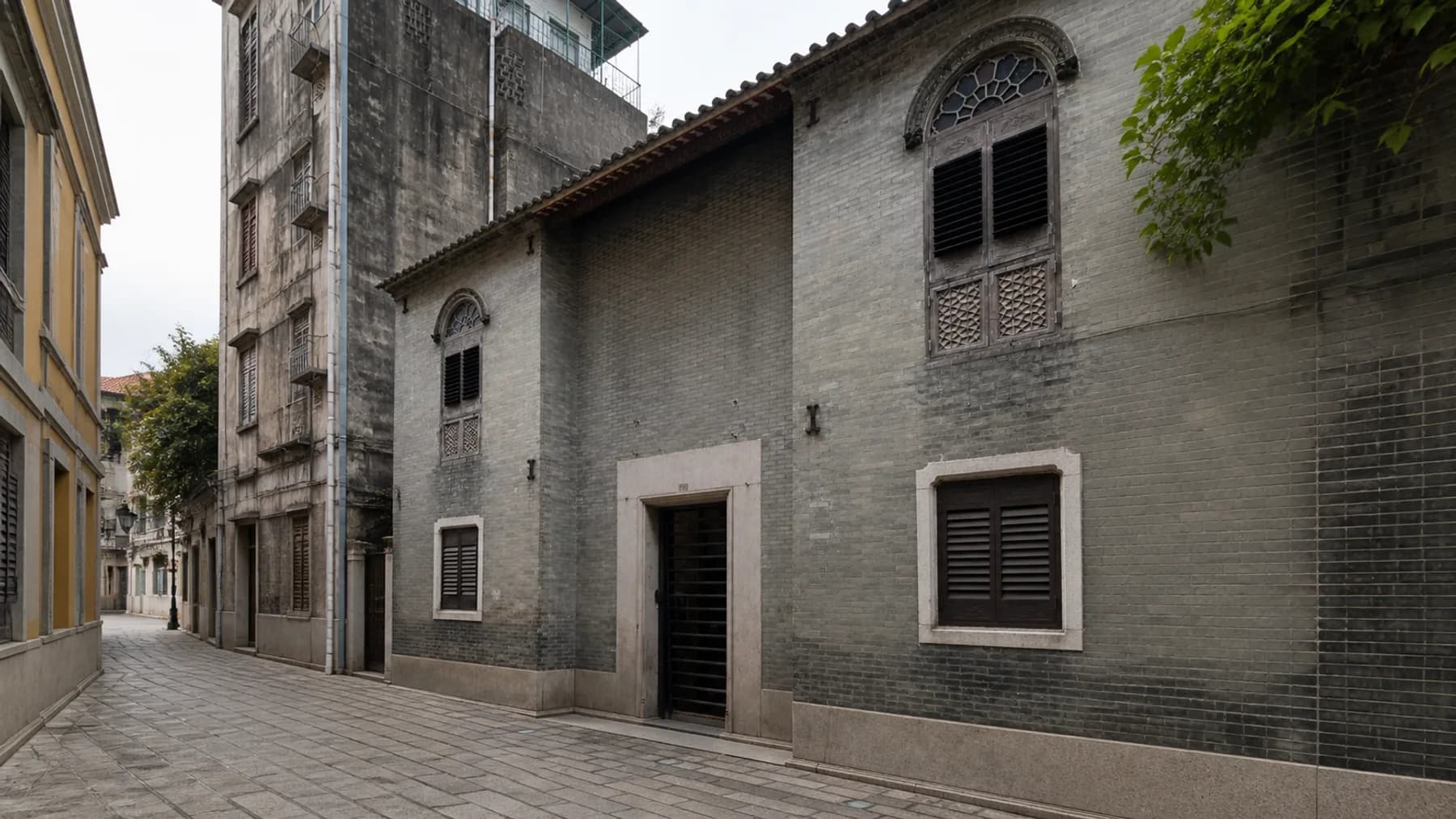
The final mapped leg is roughly 0.1 km / 1 minute, though finding the entrance and crossing the lane takes longer. Allow 45–75 minutes inside Mandarin's House. Its late-Qing compound, associated with reformist Zheng Guanying, supplies the domestic and intellectual counterpart to A-Ma Temple's maritime worship.
The diagram is an original schematic, not a turn-by-turn map. Distances use verified GCJ-02 AMap locations; use the live map for the exact turns and current closures.
Food nearby: match the meal to the route
The streets around Barra and Rua do Almirante Sérgio work better for a seated Macanese or Portuguese lunch than for a viral-snack crawl. Look for a current menu, visible prices and dishes cooked for the table: minchi, African chicken, bacalhau preparations, clams or seasonal vegetables. A proper meal can take an hour, so eat after the temple rather than carrying food through active worship space.
If you are walking to Mandarin's House, save a small bakery stop for later in the route. Almond biscuits and an egg tart are convenient, but they are not a substitute for understanding Macanese cuisine. Avoid choosing a shop only because an old post calls it a “must eat”; opening hours, ownership and quality change faster than the heritage route.
Getting there without brittle bus advice
From Taipa or Cotai
Use the Macau LRT to Barra station, then follow the signed outdoor route. The verified AMap walk is about 0.5 km / 7 minutes. This is often easier to explain than a fixed bus list and avoids crossing the peninsula by taxi at busy times.
From Senado Square
Choose between a southbound bus/taxi and a deliberate heritage walk. Walking the full distance is worthwhile only when you want the intermediate churches, squares and lanes; it is not a quick transfer. Use live Macau transport information because routes and temporary stops change.
By taxi
Ask for A-Ma Temple or Barra Square, then finish at the pedestrian edge. During festivals, the practical drop-off point may move away from the gate.
Where to stay
- Macau Peninsula: best for early access to A-Ma Temple and for walking several UNESCO clusters over two days.
- Taipa: useful for neighborhood dining and an LRT connection toward Barra without sleeping in the busiest historic-centre lanes.
- Cotai: best when resort facilities and evening shows dominate; reserve one focused peninsula day rather than squeezing the temple between resort stops.
Compare Macau hotels on Trip.com after choosing the district. On the peninsula, inspect the actual walking route and elevation: a hotel that looks close in a straight line can sit beyond steep streets or awkward crossings.
A realistic half-day
- 8:00 am: enter A-Ma Temple and follow the lower-to-upper hall sequence.
- 9:00 am: pause in Barra Square and begin the heritage walk.
- 9:15 am: Moorish Barracks exterior.
- 9:30 am: Lilau Square.
- 9:40 am: Mandarin's House, subject to its separate opening day and hours.
- 11:00 am onward: sit down for lunch in the southern peninsula or continue north only if heat and energy allow.
This sequence gives the temple enough attention, turns the nearby streets into part of the story and avoids reducing south Macau to a rushed prelude before St. Paul's.